
When the Clock Ran Out
Faith, Friendship, and the Barton Miracle
Mike Eatmon
Edited by Brandon Narron
Foreword by Coach Ron Lievense
Publication
Copyright © 2026 Mike Eatmon. All rights reserved.
November 2026 edition. Written by Mike Eatmon. Edited by Brandon Narron. Developed and prepared with AI tools under the editor's direction, from the author's testimony, recorded conversations, and the sources identified in this book.
Photographs and other third-party materials retain their respective rights.
Dedication
In memory of Roger Temple,
my dear friend.
Foreword
When Darla and I came to Wilson in 1996, we wanted to become part of the community. We were raising our family, beginning a new chapter at Barton College, and looking for a church home. At Raleigh Road Baptist Church, we met Mike Eatmon.
If you know Mike, you know he does not leave you wondering whether you have been welcomed. His warmth and enthusiasm made an impression on us from the beginning. What started with a meeting at church became a friendship that has lasted through many seasons of our lives.
Long before the national championship, Mike was coming to games and finding ways to help. He and others from church helped provide shoes for our players. People throughout Wilson gave what they could, whether that was financial support or encouragement from the stands. At a small college, that support makes a difference.
Mike came to know our family and the people around the program. He saw the work that went into it and shared in the joy when things went well. That is the perspective he brings to When the Clock Ran Out: the experience of a friend who became part of our lives.
I learned to value those relationships by watching my father, who coached at Normandale Community College. I grew up around his teams and eventually had the opportunity to play for him. When he died, former players came back and told me what he had meant to them. Their words confirmed the kind of coach I wanted to be. I wanted the young men entrusted to me to carry something useful into the rest of their lives.
My faith has always been part of that responsibility. I considered going into youth ministry before choosing coaching, and I came to see that a coach could serve young people in a meaningful way. I prayed about the players we recruited and the decisions I made. I needed God's guidance in the daily work of coaching, especially when I did not have an easy answer.
The 2006-07 season tested all of us. We faced injury, disappointment, and stretches when we had to reconsider how we were doing things. One of the most important moments came in a locker room after a difficult loss. We sat together and talked honestly. I listened to what the players needed me to change, and I told them what I needed from them. Each of us had a responsibility to the others.
I hope readers will give those moments their attention. The pressure of that season gave our young men opportunities to grow, and it required me to keep growing with them.
Winning the 2007 national championship was an extraordinary blessing. I remain grateful for the players and coaches who did the work, for Darla and our family, and for everyone at Barton and in Wilson who supported us. After the game, I spoke with our college president about what it all meant to me. What mattered most was the growth of those young men and what they were learning about handling adversity and success.
Over the years, former players have continued to call, send messages, and come back to visit. Those relationships mean a great deal to me. The kindness and gratitude they have shown are among the most rewarding parts of having been their coach.
I am thankful that Mike wants to preserve this story. Whether or not you follow basketball, my hope is that you will come to care about the people who made those years so meaningful to us, and recognize God's grace in the care they showed one another.
Mike was there long before the final seconds in Springfield. I am grateful that, all these years later, he is still my friend.
Coach Ron Lievense
Prologue: Forty-Five Seconds
With about two minutes left in the national championship game, a security man came over to tell me goodbye.
He had enjoyed seeing us again. Our boys had fought hard. Now he needed to move his people toward the Winona State fans and get ready for what would happen when they won.
That is how I remember the conversation. I remember objecting to the timing.
There was still a game going on.
By then, he knew about our “We Believe” business. My friend Jim Baldridge and I had made sure a good portion of that building knew about it. We had come a long way from Wilson, North Carolina, and we weren't planning to get quiet before the horn.
The security man had a reasonable argument. Winona State was the defending champion. Fifty-seven straight wins. They had beaten us in this same tournament a year earlier. This afternoon, they were ahead again.
I had a friend on the Barton bench.
I had known Ron Lievense since he and Darla brought their family to our church eleven years before. I had watched him coach in a small gym, helped when I could, and cheered for players whose names most of the country hadn't learned. He had given years of his life to those young men. Some of them were about to play their last college possessions.
I wanted them to hear us.
The security man went ahead with his work. I went ahead with mine.
Then the game narrowed to forty-five seconds.
Winona State, seventy-four. Barton, sixty-seven.
Seven points. Less than a minute. The team across from us hadn't lost a game all season.
There are people who watch the replay now and tell me they still can't believe what happened. I understand. A replay gives you the comfort of knowing the ball is going to get another chance. In the stands, we had no such arrangement.
We had Anthony Atkinson, a point guard we called Ant. We had boys who had kept finding ways to stay in a game long after I thought my nerves had done enough for one evening. We had a coach who had nearly left Barton after the previous season.
And we had time.
Very little of it. But I wasn't ready to say goodbye.
To understand why that afternoon meant so much to me, you need to meet the family who came to church.
Introduction: The People I Want You to Know
In my real estate office in Wilson, I keep a basketball signed by the team and a framed photograph of the 2007 champions. They belong to a season I still love to talk about. They also belong to people whose lives had been crossing mine for years before the country learned their names.
A visitor can see a trophy season in those signatures. I see evenings in Wilson Gym, a friend on the bench, and young men I had come to care about. I remember what it was like to worry for them before anyone could tell us how the story would end.
That is the place I am telling it from.
I wasn't the coach. I wasn't the point guard. Nobody was putting me in with the game on the line.
I was a friend and a fan. Sometimes my contribution was buying a bag of mints and trying to persuade strangers to pull for Barton. Sometimes it was asking Ron what the team needed. A good deal of it involved making more noise than the people near me had expected when they bought their tickets.
I enjoyed myself. I also cared about those boys.
When Darla Lievense introduced herself at church in 1996, I couldn't have imagined where the friendship would take us. Ron was the new basketball coach at Barton College. His gym was about five minutes away. I started going to games, and before long the team had become part of my life.
That is the Barton I want you to know: a college in Wilson, North Carolina, where you could see the coach at church on Sunday and watch him work during the week. You got to know his wife and daughters. You learned the players' names. If something went wrong, the people you worried about were people you knew.
Plenty went wrong in the championship season. Alejo Barovero broke his shooting hand. A thirty-four-point loss left the team with questions it couldn't avoid. Close games kept asking for more time, until overtime seemed to be a place our boys had taken up residence.
Ron saw those things from inside the team. I saw them from the stands. Later, when we talked through the years together, his account filled in much that a fan couldn't have known. You will hear both perspectives, with Ron's memories kept in his care and mine in mine.
My Christian faith is part of this story. So is Ron's understanding of coaching as a calling. I believe God worked through the people who gathered around that program, and I am grateful for what we were allowed to share. You are welcome here whether you understand the season that way or simply love a good basketball story.
The players wearing Winona State uniforms deserve a place in it, too. Their excellence gave the championship its weight. Our joy came at the end of an afternoon that hurt them. Remembering that keeps my gratitude honest.
What happened in Springfield made Barton famous for a little while. What brought us there had been happening for years.
I worry that much of that longer story could go untold. Ron is not going to organize his life around telling people how much he has done. I love that about him. It also leaves something for a friend to do. I have watched him give years to young men whose names may never appear in a championship account. I want those years remembered, too.
But even a book that makes Ron more fully known can miss what matters most to me. I believe this is God's story. Ron is a man God has used, and the championship is one part of a much longer work. I saw God's involvement in the years of service, the friendships, and the help people gave one another, not only in the seconds when the whole country could see the score change.
That conviction is why I cannot leave the story alone. I want you to know my friend, and I want you to see why I give God the credit. Ron would do the same. The privilege, for me, is getting to tell it.
Part I - The Work Before the Witnesses
Chapter 1: Wilson
Darla Lievense introduced herself the first Sunday her family visited Raleigh Road Baptist Church. It was 1996. She and Ron were new to Wilson, and he was the new basketball coach at Barton College. I remember that introduction because so much of what followed began there, with a family I wanted to get to know.
Now, getting me interested in basketball doesn't require a great sales pitch. This is North Carolina. We love our basketball. But here was a team about five minutes away, coached by somebody I knew. I could see Ron at church, go watch his boys during the week, then see him again with Darla and their three daughters. The coach and the man were the same person, moving through the same little community I was.
Wilson was already home to me. I have lived here all my life. In the fall of 1984, I attended Atlantic Christian College while working two jobs. I had hoped to go to Chapel Hill and become an attorney, but that wasn't the path I took. Around Thanksgiving of my freshman year, I left Atlantic Christian to pursue business and sales. I knew the place before I knew its new coach. Meeting Ron gave me a personal reason to keep walking into its gym.
So I started going to games. I was there to support my friend.
I told Ron I would be loud. No profanity or calling people names, but he would know I was there. When I asked where he wanted me in Wilson Gym, I remember him directing me to a courtside seat diagonally across from him, on the other side of the court. He wanted me to bring my buddies and the church people and encourage the team from over there. He had his work on the bench. I had a place to put my voice.
Roger Temple, one of my best friends, was by my side for home games and as many away games as we could make. We had our own “superstition”: Roger had to sit to my left for everything to be just right. That was how we sat at every game we attended together.
The Words We Carried
Shereen Mitchell helped give that encouragement words. She was a church friend and an Atlantic Christian graduate who came to games with her husband. In the game I remember, she was behind me, and I was offering an unnecessary amount of commentary about our chances.
The game was still in the balance. I was beginning to sound as though it had already been decided against us.
Shereen called my name. She wanted to know whether I believed.
I did. So did she. Then we had something we could say together.
“We Believe.”
Other people picked it up. The church crowd helped carry it, and people around us joined. A reminder one friend had given another became something a whole section could offer the players.
I cannot give that first exchange a date with the confidence I can give you a final score. When Ron and I returned to the memory, we associated the chant with the middle of January during the championship season. Shereen's scrapbook preserves her own account, placing its beginnings at the March 14, 2006 regional game against Alderson-Broaddus. Another note in the scrapbook remembers the Raleigh Road cheering section a year before the championship. I want her record beside our recollection. The words had a history before Springfield's final afternoon.
What I remember most clearly is the correction. I had been describing what looked wrong. I understood her correction as a reminder to use that voice to encourage the boys who still had a game to play.
We didn't need the chant every time Barton scored. If we were playing well and comfortably ahead, I could find plenty to say without it. We brought those two words out when our team needed us to stay with it. I remember sometimes telling people to wait: this wasn't the moment for it yet.
For me, the words carried my Christian faith as well as my hope for our team. Through God, I believed, things were possible that I could not see a way to arrange myself. Somebody beside me might have joined simply because he wanted Barton to win. He had a place in our crowd too.
Ron remembered the encouragement reaching the players. He valued the sound of a crowd that hadn't quit when the game looked difficult. A young man could hear that the people who knew him were still there, still expecting him to have something to give.
The players supplied the basketball. We could supply a voice that stayed.
Other people came for much the same reason. Some had attended Barton. Some knew the college by its old name, Atlantic Christian. Others had no particular tie to the school. They liked basketball or had gotten to know the Lievenses, and there was a game down the road. Once you knew the players and the people sitting around you, going back felt natural.
That's the Wilson part of this story. Long before the country saw our team on television, we had years of ordinary evenings together. We had wins worth talking about and losses that made the next game seem a long way off. The players became familiar to us while they were still figuring out what kind of team they could be.
Wilson Gym helped make that possible. It opened in 1966, and by the time Ron was coaching there, the building showed its age. Wood bleachers. No air conditioning. A place where the people watching could get close to the people playing. Our gym had very little interest in pretending to be an arena.
When Barton earned the right to host the regional, some visiting coaches complained. Ron told me they thought a tournament that important deserved a better facility. I could see what they were looking at. But our boys had earned the home court, wood bleachers and all.
A small gym gives a supporter certain advantages. You can make yourself heard. You can see the players' reactions without waiting for a camera to find them. And the people around you are likely to be people you'll see again. They may be your church friends or somebody you run into during the week. Cheering travels a short distance in a place like that.
I have always been willing to help it travel.
The college's size shaped more than the atmosphere. Ron carried several jobs, and his assistant was part time. The program had needs that a larger school might cover without much discussion. We could enjoy the closeness while recognizing that somebody still had to pay for equipment, organize travel, recruit players, and find enough hours to get everything done.
After the championship, the state resolution honoring Barton listed its full-time undergraduate enrollment at 925 students. That gives you a useful measure of the place: fewer than a thousand full-time undergraduates, sending a team into a national field. Some of the schools waiting for us in Springfield had student bodies many times larger.
We were used to explaining where Barton was. Soon we would be explaining what had happened there.
A College Built Around Light
The school had been in Wilson since 1902. Atlantic Christian College opened with 107 students and a single building, Kinsey Hall. Its connection to the Christian Church, the Disciples of Christ, placed faith and education together at its beginning. The motto, Habebunt Lumen Vitae, means “They shall have the light of life.”
On September 6, 1990, Atlantic Christian became Barton College, named for Barton W. Stone, a leader in the Disciples of Christ Church. The new name took time to travel. Ron discovered that when he went recruiting. Before he could explain what he wanted to build, he sometimes had to explain that Barton was the school people already knew as Atlantic Christian.
The athletic program was changing too. Barton entered NCAA Division II in 1995–96 after its years in the NAIA. Division II has its own national championship. The Elite Eight is the last eight teams still playing for it. Athletic director Gary Hall helped guide that move. During his tenure, the college expanded from nine intercollegiate sports to eighteen. Ron arrived while the school was learning how to compete in a different setting, and his basketball program became part of that larger effort.
A lot of people had work invested in the place before I began walking into the gym. I think about that when somebody describes Barton as an unlikely little school that appeared out of nowhere. It appeared suddenly to them. In Wilson, the college had been part of people's lives for generations.
The team drew some of its players from those same local relationships. Anthony Atkinson was from Wilson and had played at Greenfield School with Errol Frails. Mike Flowers was another Greenfield player. Bobby Buffaloe came from Fuquay-Varina, Charles Gamble from Snow Hill, and Spenser Briggs from eastern North Carolina. Other players had Raleigh-area connections.
Then there were the young men who had traveled much farther: Jeff Dalce from East Orange, New Jersey; Brian Leggett from Alexandria, Virginia; Alejo Barovero from Mar del Plata, Argentina. Some of the boys could go home nearby. Others were a long way from their families. All of them were trying to make a life at this small college.
Ron and Darla threw themselves into the community. When we later talked about their first months in Wilson, he described the friendships at Raleigh Road as an important part of the support around the program. They lived about a mile from campus. The family, the church, and the college were close enough to become part of one another's daily life.
I watched the girls grow up around their father's players. Sometimes they wore little cheerleader outfits to games. When a game ended, Darla and the girls made straight for Ron. He was their husband and daddy before anyone had finished discussing the score.
A difficult night in front of a whole gym was still a night when his daughters came looking for their daddy. That is how I remember his family at Barton. All three girls eventually graduated from the college. They had grown up around the team long before they enrolled.
By the time of the 2005–06 season, Ron had given nearly a decade to Barton. That team won twenty-eight games, took the conference and regional titles, and reached the Elite Eight for the first time. We went to Springfield proud of them. We came home with an overtime loss to Winona State, the eventual national champion, and the knowledge that we had been close.
The next season brought the same coach, many of the same players, and a community ready to follow them again. We had reason to hope. We also knew exactly how a wonderful season could end.
To understand why we wanted to follow Ron into another season, you have to go back before Wilson. Back to another small-college gym, and to the recruiting calls his father made on the family telephone.
Chapter 2: A Higher Calling
There was one telephone in the Lievense house. At night, Ron could hear his dad using it to recruit players.
When I asked Ron how he came to coaching, that was one of the details he gave me. His father, Ron Lievense Sr., was the athletic director and basketball coach at Normandale Community College in Minnesota. He helped establish the athletic program there. Basketball followed him home, and his son grew up hearing the work continue after practice was over.
Ron went along on scouting and recruiting trips. His great ambition as a boy was to play for his father, and eventually he did. He later told me that what he learned about the game was only part of the inheritance. He had watched the way his dad related to young men.
A recruiting call asked a family to trust a coach with some of a young man's most important years. Ron was hearing that responsibility enter the house long before he had players of his own.
Years later, his father died at sixty-five. Former players came back for the funeral and told the family what he had meant to them. Ron was already coaching. Listening to men whose playing days were long behind them helped confirm why he wanted to do it.
Their return is the part I keep coming back to. His father had stayed important to those men after they no longer needed a coach. Now the family got to hear how much of his work had lasted.
The Coach's Son
Ron considered youth ministry while he was working his way through college. He also wanted to coach. In time, he came to believe the gym offered a place to do both: teach basketball and serve young men during years when they were learning who they would become.
That made sense to me because it fit the man I knew. His faith belonged to his everyday life. He prayed about the people he recruited and believed he had a responsibility to them beyond the next game. A parent was trusting him with a son. A player was giving him a few years he couldn't get back.
When I try to describe how Ron approaches that responsibility, I think of an audience of one: God. I mean the One to whom he understands himself to be accountable, whether the bleachers are full or almost empty. His decisions still have consequences for the people around him. Faith makes those people and those decisions matter more.
I asked Ron how he persuaded families to make that choice. Wilson wasn't going to offer every attraction a young person might find in a bigger city. There had to be something in the coach, the college, and the opportunity that made a family comfortable saying yes.
He talked about players who accepted the work, got better, and stayed. Some had been overlooked by larger programs. At Barton, they found a coach who believed they could develop and teammates who expected them to keep at it. Their progress helped the program, and several eventually earned opportunities to play professionally.
Ron was competitive about all of it. He studied opponents and expected effort. He corrected mistakes. Caring about a player's future gave him more reason to insist that the young man take his responsibilities seriously. Those demands were part of the relationship he was offering.
His own introduction to coaching came in small assignments. He volunteered with his dad. He coached a ninth-grade team at his old school. His college studies took longer after he changed his direction toward physical education, preparing to teach as well as coach. He was already married, finishing his education and finding his way into the profession.
Then Winona State gave him a graduate-assistant position.
Yes, that Winona State. Years before we wanted so badly to beat the Warriors, Ron had been working in their program. He taught classes, recruited, and coached on the floor. The assignment let him see the whole job, and he loved it. He told me he would have stayed if there had been money for a full-time position.
That history gives me another reason to respect Winona. Its program had helped my friend learn his profession. Ron could be grateful for that opportunity and still want to beat the Warriors every bit as much as the rest of us.
At the time, the next opportunity was somewhere else.
Southbound
Averett in Danville, Virginia, offered Ron his first full-time head-coaching job. He was twenty-seven. The program hadn't won a conference game in two or three years, as he remembered it, and the facilities were poor. Other people weren't eager for the opening.
Ron saw a chance to build. He told me he had always taken jobs for the opportunity to make a difference. This one would give him plenty to work on.
Darla hadn't seen Averett when they moved. Ron had been there once, for his interview. They left Minnesota for Virginia with the coaching job ahead of them and little familiarity with the place. A career history can put that move into one sentence. A couple has to live it.
They spent three years at Averett, and Ron helped make the program competitive. He then spent four years at Campbell as an assistant under Billy Lee, a coach he admired. Five years leading St. Andrews followed. There, partial scholarships complicated the work of building a team.
Each school presented a different set of possibilities and limits. Ron had coached under somebody else, taken responsibility for a program himself, and learned to recruit for places that couldn't promise everything a young man might want. By the time Gary Hall called about Barton, he understood what a demanding small-college job could ask.
Gary needed a coach. Ron was interested. In 1996, the Lievenses moved to Wilson.
Ron still described the hiring as Barton taking a chance on him when we discussed it years later. He spoke warmly of Gary's character and the pleasure of working for him. That gratitude survived the pressures that would come with the job.
The first team went 22–5 and made the school's first NCAA tournament appearance. That's a pretty good introduction. I had started attending to support my friend, and he immediately gave us a team worth getting excited about.
Success brought its own expectation. The college had shown it could reach the tournament. Now there were new players to recruit and new teams to develop. Ron still had teaching, advising, and compliance responsibilities. The day after a good season, those jobs were waiting alongside the next basketball season.
By 2006–07, Joel Zimmerman was handling a large share of the program's daily work, from recruiting and scouting to academic support and camps. John Skinner brought Wilson roots and experience as a student manager and statistician at North Carolina. Their responsibilities filled the space around the games most of us came to watch.
Ron also remembered how he and Joel found ways to laugh about the difficulties. There had been plenty of times, he told me, when they could have chosen to cry instead. They chose to laugh. That didn't make the jobs disappear.
Before the national tournament in March 2007, Ron's Barton record stood at 206–102. He already had four conference coach-of-the-year awards. Those figures represented a decade of recruiting promises, player development, adjustments, and evenings when the work hadn't produced a win. He had stayed long enough for people to see how he handled both kinds of night.
What Staying Cost
After the 2005–06 breakthrough, Ron and Darla seriously considered leaving.
He told me that when we went back through the story. Funding discouraged him. He was teaching, advising, coordinating compliance, and coaching. His assistant was part time. Some of the schools Barton was beating could give their basketball staffs support that ours didn't have.
From the stands, we could celebrate a regional title and the first trip to the Elite Eight. Ron and Darla had to return home and consider the demands that would still be there next year. They discussed whether another move might make sense.
That is an important part of knowing my friend. His faith didn't keep him from getting tired. He loved coaching those young men and could still question whether the arrangement was sustainable. Darla was part of that decision because she and the girls were living with the work too.
Ron stayed. There was no assurance that the next season would repay the decision with something better than the one before. He would have a team to prepare, a family to care for, and the same small gym. Whatever came next would have to be earned under those conditions.
When Barton eventually put his name on the court, people could point to victories and years of service. I could also remember the period when staying had been a question. That makes the years mean more to me. He kept making a commitment that he and Darla had actually examined.
The next season would test the players. Before it began, their coach had faced a question of his own and decided to be there.
Interlude: The Court as a Place of Calling
I believe God can use the work in front of us. Most of that work comes without much attention. Somebody needs help, you have something useful to offer, and you decide whether to offer it.
Ron found his place in a gym. I found a place alongside it as his friend and a supporter. He had to prepare the team and make decisions I would never have to make. I could bring people to games, encourage the boys, and help when a practical need came along. There was enough work for all of us.
Colossians 3:23 calls us to work wholeheartedly for the Lord. I hear something practical in that. The care a job deserves doesn't depend on how many people are watching. Those young men deserved Ron's attention while Barton was still a name he had to explain to recruits.
I think about his father's former players coming back. A coach had spent time with them years earlier, and they still had something to tell his family. The relationship had traveled farther than any one season.
Ron received help too. When he talked about what the program had become, he named his assistants, the players, Darla and the girls, and friends from church. That is part of a calling I recognize: you offer what you have, then find yourself depending on what other people can give.
In Wilson, we were close enough to notice one another's needs. Sometimes the next useful thing was as ordinary as a pair of basketball shoes.
Chapter 3: The Long Work
Getting Ron to tell you what he needed could take some work. He wasn't a man who came around with a shopping list. I remember asking what we could do for the program and having to draw an answer out of him.
The answer was shoes.
The boys wore through basketball shoes quickly. Some of us at church got together to buy them shoes, but first we had to work through what was allowed.
You had to pay attention to the NCAA rules. In those days it could feel as if you needed a ruling before you offered a player a stick of gum. Helping Ron was the idea; giving him a new problem wasn't. We found the proper way and bought the shoes.
That is a memory I enjoy. We knew the coach, found out what the players needed, and did something about it. A young man needs shoes that will hold up whether he is playing for a national title or getting through practice on an ordinary afternoon.
When I reminded Ron about the shoes, he thanked us and then began talking about the other people who supported the program. Raleigh Road was part of it. So were people throughout Wilson. Some could give money. Some could come to games. He valued what each brought.
That is a familiar turn in a conversation with Ron. Ask about something he built, and before long you are hearing about the people who helped him build it. The shoes gave me a small, useful way to be involved. His gratitude made room for everybody else too.
Our involvement gave us a real place around the team. We could help make the work possible and show up to encourage the people doing it. Once you had gotten to know those young men, you wanted to see what they could become.
The People Behind the Finish
Ant would eventually become the player most people associated with Barton. Around him was a group with different abilities, backgrounds, and amounts of playing time. Getting all those differences to work together was Ron's job.
Bobby Buffaloe had earned a conference freshman honor in 2005–06. He could score efficiently, help create offense, and take some of the burden off the point guard. Errol Frails had come from Greenfield with a reputation for defense and leadership as well as scoring. Jeff Dalce became another defender Ron could rely on.
When Ron talked about Jeff, defense was where he began. Jeff had offensive limitations, especially farther from the basket, but he could make life difficult for the player he was guarding. The team needed that ability. An opponent preparing for Barton had to think about what happened before it ever got a shot.
Brian Leggett worked closer to the rim. Rebounding required him to finish possessions that somebody else's defense had started. Blocking a shot could end a threat or make a player reconsider the next drive. That work can be overlooked when the next basket goes in, even though a team won't get very far without it.
Mark Friscone came through Lakeland Community College with size and a perimeter shot he continued to develop. His scoring role would grow as the team needed more from him. Ron later singled out that development when we discussed how the season had changed the players.
David King gave us useful minutes inside. L.J. Dunn was a freshman finding a place in a college lineup. Behind them were players preparing for minutes they couldn't count on receiving. Their work attracted little attention outside the program, but Ron needed more than five men ready when a game began.
From the stands, I could see the shot or the turnover. Ron could tell me what he had been asking a player to learn and how far the young man had come. That's one reason our conversations mattered. A player I saw making a mistake might also be attempting something he hadn't been capable of a season earlier.
Ron described some of his best years at Barton in terms of players who bought into the work and stayed. They got better together. A coach could learn what a young man would respond to, and teammates could learn what they could trust one another to do. The next season began with some of that knowledge still in place.
Players also had to find a place within unequal responsibilities. Ant would handle the ball more than anybody. Other players might be asked to defend or rebound for long stretches without having a play run for them. A substitute could prepare all week and receive only a few minutes. Those are real differences, and the team had to make them useful.
I wanted the players who received less attention to know we were watching them too. A rebound was something to cheer. So was a defensive stop. You didn't have to wait for a spectacular shot to let a boy know you appreciated what he was doing.
What the Numbers Remember
When I look back at the season record, I find evidence of that shared work. Through the East Regional, Barton had fifty-six more steals than its opponents and a substantial advantage in points off turnovers. Our pressure was producing chances, and the team was using them.
The bench comparison was much closer. Our reserves had scored 727 points. Opposing reserves had scored 725. Two points separated them over thirty-three games.
There wasn't much room to boast about a scoring advantage there. Our reserves were helping keep games within reach, covering minutes, and giving Ron different combinations to use. The two-point edge couldn't tell me all of that, any more than it could tell me what a player did in practice to be ready.
The scoring itself came from different parts of the floor. Mark led the team in made three-pointers through the regional. Brian's rebounding supplied extra possessions inside. Bobby could get points and create opportunities for somebody else. Ant had to read all of that while a defender was trying to take the ball from him.
The point guard's figures carry both his production and his mistakes. Before Springfield, Ant had 204 assists and eighty-six turnovers. The team was asking him to make decisions at speed for most of every game. He couldn't become so afraid of an error that he stopped creating.
It is easy to want an aggressive point guard and then object to the risk that comes with him. From the seats, we have time to discuss a decision he had to make at speed. Ant had another possession to handle.
A player couldn't wait to feel better about a miss before getting back on defense. A substitute couldn't wait until Ron called before preparing to enter. Ron and his staff were trying to make that readiness ordinary.
Years later, Ant praised the defensive work David and Brian did against Winona's size. I appreciated hearing the team's most celebrated player name labor a scoring total could overlook. He knew who helped make his opportunities possible. That is how I want to remember the rest of the roster too.
A Family in the Program
There was another way I saw people finding a place. Some players couldn't get home for the holidays. The Lievenses welcomed them into their house. There were invitations to church and time together away from the gym.
I watched the boys respond to the girls as the family made room for them. The children knew these young men. They were part of the world their father lived in, and the players knew they mattered to that family. Over years of ballgames, those relationships became as familiar to me as the uniforms.
Ron made that care personal for me, too. Over the years I received cards, texts, and voicemails from him, checking on me even in the middle of a season. His plate was already full. He still wanted to know how I was doing. I didn't have to guess whether friendship mattered to him; he kept making time for it.
Being close didn't make every young man easy to coach. I asked Ron about the difficult side too: players resisting the system, having trouble in class, or failing to give the effort the staff expected. Those problems still had to be addressed.
Ron could draw on that history when he had to correct a player. The young man had seen him care about more than scoring; Ron had learned more about him than one bad game could reveal. They could disagree and still have somewhere to begin.
The relationships continued after college. Ron told me about calls and messages from former players and about men coming back for his retirement celebration. That brought his father's story around again. Young men had become adults with lives elsewhere, and the coach was still somebody they wanted to thank.
By the time Barton reached Springfield in 2006, much of this work had been going on for years. There were coaches and assistants behind it, families and church friends around it, and players learning how their different abilities could fit.
The point guard who helped bring those possibilities together had taken a detour before finding his way to Wilson.
Chapter 4: Ant
Anthony Atkinson came home by way of Campbell University. He had grown up in Wilson, played at Greenfield School, and earned the Division I opportunity a talented young player hopes for. Then he chose to return to the college down the road.
That choice gave Ron the point guard he had wanted for years. It gave people in Wilson another reason to walk into the gym.
Ant was listed at five feet ten. If you started by comparing him with the bigger men on the other team, you could spend a while worrying. Then he would get the ball, and the question became how much space he could find before anybody closed it.
He could get a defense moving, recognize an opening, and use it before the opening seemed obvious to the rest of us. He could score and find somebody else. His responsibility was to keep four teammates involved while deciding what the possession required.
I loved watching that kind of basketball. You might know a play was supposed to develop one way, and then Ant would recognize what the defense had given him. Suddenly the game had moved somewhere else.
The Decision to Come Home
Ron had followed Ant since his younger years and recruited him out of Greenfield. Ant wanted to try Division I, and Billy Lee signed him at Campbell. Lee left soon afterward. Ant later described having a different connection with the new coach and deciding after his sophomore year that he wanted to transfer.
Barton was looking for a point guard. Tim Black had been an outstanding player for Ron before moving on to a long professional career in Europe. A junior-college player had helped fill the position afterward, and now the team needed somebody to take charge again. Ron's system asked too much of the position for him to treat it as a minor vacancy.
Ant's father called. Ron remembered being asked whether Barton would still be interested in Anthony.
He was delighted. They had wanted Ant before he went to Campbell. The choice of another school hadn't changed what Ron thought the young man could do. A Wilson point guard with that ability could transform the team and draw people who already knew his family and his game.
Ant had other possibilities. He chose Barton, and later spoke about wanting to do something special for Wilson. Some of the people in our gym had followed him before college. Coming home meant letting them follow the next part of his career from down the road.
Errol Frails had played with him at Greenfield. Mike Flowers also had Greenfield ties. Those relationships joined the players who had arrived from farther away. Ant knew the town, but he still had a new team to learn and a college career to finish.
Ron prayed about the players he recruited. When we talked about it, he said he wanted the young men God intended him to coach. He still needed to evaluate the basketball fit, and with Ant the need was clear. His prayer concerned the person he would be responsible for as well as the point guard he hoped to put on the floor.
Ant's Christian faith mattered to him too. Ron spoke about his character with affection and respect. They had a shared belief, a coach's confidence built over years of watching, and a player ready to accept the opportunity. That was a strong place to begin.
I think coming home can take more resolve than people recognize. Ant had wanted Division I and earned his chance there. Now he was making another decision about where he could do his best work. At Barton, the responsibility would be substantial. He would have the ball, and people would expect something from him.
More Than a Scorer
In his first Barton season, Ant averaged 18.4 points, five assists, and 2.6 steals. He became the conference Player of the Year and earned first-team all-region recognition. The players who guarded him knew what kind of challenge he presented well before a national audience learned his name.
The assists belong beside the scoring. If a defense gathered around him, somebody else ought to have an opportunity. Finding it was part of his job. Holding the ball so much meant he could either help a teammate become more effective or leave that teammate standing around.
By the spring of 2007, Ant was playing more than thirty-eight minutes a game. Nearly a whole game of deciding when to attack, when to give up the ball, and how to get the offense moving again. Whatever the last possession had cost him, Ron needed his judgment on the next one.
Some nights the responsibility showed up in a big scoring total. He had thirty-four at Chowan and thirty-one in a double-overtime win at Anderson. Other contributions were harder to isolate: drawing a defender, making the pass, recognizing when a teammate had a better chance.
For all his ability, he made mistakes. There were turnovers and missed shots. The team still needed him to take initiative afterward. A point guard who retreats from responsibility because the last possession went wrong can leave four other players waiting for a decision.
Ron trusted Ant with that burden. His teammates had to help carry it. They could make a possession easier with a rebound, a screen, movement away from the ball, or a pass that arrived where he could use it. The team kept becoming more effective as those relationships developed.
What I saw in Ant was a willingness to remain involved. The game might turn against us, but he was still looking for something he could do. That quality would matter in a season that offered very few guarantees.
What His Father Had Given Him
When Ant later explained his calm under pressure, he went back to the work he had done with his father. They practiced late-game situations when he was young. His dad taught him to read the clock, stay mentally tough, and keep an opponent's success from taking over his attention.
From the stands, a quick decision can look like something a player discovers in the moment. Ant had spent years working through those moments with his dad: read the clock, handle the ball, decide what to do. His father couldn't know which game would call for that preparation. He could keep helping his son prepare.
Ron brought an inheritance from his father too. He had heard recruiting calls and watched relationships continue after players graduated. Ant had worked through basketball problems with his dad. Two sons arrived at Barton carrying different kinds of preparation, and their work met in the same team.
I admire the patience in that. Somebody has to spend the time with a young person before anyone knows what the time will produce. A father doesn't get a guarantee that a drill will someday appear on television. A coach doesn't know which recruit will become the player he needs most in a difficult moment.
Ant's preparation helped him recover as well as decide. After a miss, there was still a clock to read and another assignment. He had practiced keeping his attention on the game when it became difficult.
We would need that steadiness in a season of injury, losses, and changing roles. Ant would have to help a team through all of it while carrying much of the scoring.
But his first trip to Springfield with Barton had come a year earlier. We had already learned how close we could get—and how much the last few minutes could cost.
Chapter 5: The First Springfield
Before there was a championship to celebrate, there was a season we didn't want to end.
Barton went 28–4 in 2005–06. We won the conference, took the East Region, and reached the Elite Eight for the first time. Those accomplishments belonged to that team. The boys had carried us farther than Barton basketball had gone before, and we were proud to follow them.
Alejo Barovero was central to the run. He averaged 16.1 points and 5.6 rebounds and became the regional most valuable player. Ant had established himself as our point guard. Casey Moore could score, Brian Leggett supplied work inside, and Bobby Buffaloe was making an impact early in his college career. We had people an opponent had to account for.
As the top seed in the East, Barton hosted the regional. Eight teams came to Wilson Gym. One would leave for Springfield.
Ron explained that Division II kept teams within regions to hold down travel costs. Several strong teams could be crowded into the same region, with only one allowed through. Hosting put that whole contest in our old gym, where the people who had followed Barton all year could be part of it.
Barton beat Wheeling Jesuit 93–70. Then we beat Mount Olive 82–79 and Alderson Broaddus 73–70. Two three-point games after the opening win. The route was narrow enough without anything unusual happening to the building.
The Backboard
During that first regional, a backboard shattered while both teams were at the other end of the court.
I was there. The game wasn't going well for Barton, and then came that startling noise. Glass fell onto the floor. Nobody was dunking on that basket or hanging from the rim when it broke. The game stopped, and a gym full of people suddenly had something other than the score to worry about.
Did we have another backboard?
We didn't have one ready to put up.
When Ron and I talked about it later, he remembered a big player dunking on that basket a few plays earlier. He believed a crack had developed and the heat and humidity had contributed to the delayed break. That was his explanation. The part I remember most clearly was the surprise of an empty basket coming apart while the basketball was happening somewhere else.
Our facilities people now had the most important assignment in the tournament. They needed a replacement that met the rules and worked with the equipment at the other end. As Ron recalled, our older backboards extended farther down than newer models. Not every available backboard would fit.
They found the right one and worked to get it installed. The interruption lasted long enough for the teams to leave and return. When play resumed, it picked up where it had stopped.
Barton came back and won. In my memory, the interruption changed the momentum. Ron had more time to work with his team than any ordinary halftime could have allowed. A game that had been getting away from us could begin again under different circumstances.
I had never seen anything like it. Years later, when Ron and I began collecting the story, I wanted that 2006 interruption in the book. I wanted the facilities people in it too. They had to find the right equipment, get it to the gym, and make the basket usable while players and coaches waited. Without their work, there was no game to resume.
Then we finished the regional and packed our hopes for Springfield.
Eighty-Six, Seventy-Eight
Winona State was our quarterfinal opponent. The university that had once employed Ron as a graduate assistant had a team capable of winning the whole thing. We knew the Warriors were good. We wanted to find out what our boys could do against them.
At halftime, Barton led 43–38.
We had played twenty minutes against the team that would win the championship, and we led by five. That is part of why the ending stayed with me. This had been a game Barton could stay in, with a chance to make our first trip last longer than one round.
The teams reached the end of regulation tied at seventy. Ron remembered a late free throw that could have put Barton ahead and didn't fall. I remembered the opportunity too. It was one of those chances you carry afterward because the next possibility had been so close.
There were still five minutes to play. Winona used them better.
The Warriors outscored us 16–8 in overtime and won 86–78. They advanced to the semifinal. Our season was finished.
The box score helps explain the separation. We shot 36.6 percent from the field. Winona shot more efficiently, outrebounded us, and took ten more free throws. Barton forced turnovers and made ten steals, but the extra possessions couldn't overcome everything the Warriors were doing.
Ant played all forty-five minutes. He finished with twenty points, seven rebounds, four assists, and five steals. Casey Moore led us with twenty-six points. Brian gave us seven points and nine rebounds. Alejo scored eight. Bobby had seven before fouling out.
John Smith gave Winona twenty-five points, seventeen rebounds, and seven blocks. David Zellmann added eighteen points and nine rebounds. Those were the performances we had to answer. Smith's presence around the basket was especially hard to forget.
Winona went on to win the semifinal and the national championship. We had lost to the team that finished the job. We had also led that team at halftime and stayed level through forty minutes. Both facts came home with us.
Ron told me the players felt they had let one slip away. Their belief that they could beat Winona came from the game they had played. They had been close enough to see the opportunity, then watched it disappear in the extra period.
As a fan, I wanted another chance too. I could respect what the Warriors had done and still want our boys back on the floor with them. Those desires went together easily enough for me.
But the calendar had turned. The 2005–06 season was over, and nobody could promise that next year's bracket would bring the teams together again.
The Summer After
Ron remembered the returning players keeping in touch during the summer. Winona stayed in the conversation. The Warriors were bringing their core back, and our boys wanted another opportunity to face them.
They weren't all together in a gym in Wilson. Barton couldn't keep the players on campus through the summer the way some larger programs could. They went home, with different responsibilities and different places to work out. Their shared ambition had to survive the distance.
The rematch was something they could talk about together. The preparation had to happen in the places they had gone home to, away from the tournament and away from one another.
The team would change as well. Seniors moved on. New players arrived. The returning group could use the loss as motivation, but the next roster had to establish its own relationships. Newcomers needed a place in the team they had joined, with responsibilities of their own.
Ron was making a decision about his future during that period too. He and Darla discussed whether the demands of the Barton job had become too much. While the players were hoping to return to Springfield, the coach who had taken them there was considering whether he could continue under the same conditions.
He stayed, and the boys came back to campus. The work resumed without any assurance of another trip. To get there, they would have to win games against opponents who had nothing to do with Winona State.
The first two offered an immediate test. Barton needed overtime to beat Elizabeth City State 83–82, then overtime again to win 106–102 against Saint Augustine's. North Carolina Central beat us 67–65 in regulation. Two close wins and a close loss gave the season an unsettled beginning.
We beat St. Andrews and Coker. Alejo had appeared in all five games. He was a senior, a preseason All-American, and one of the players expected to help carry the team back to Springfield.
Then he broke his hand.
Part II - What Pressure Removed
Chapter 6: A Hand and an Absence
The player Barton lost after five games had come a long way to be there.
Alejo Barovero was from Mar del Plata, Argentina. He was six feet seven, a biology major with a grade-point average close to four, and a senior whose basketball had helped carry us to the previous year's Elite Eight. His game had developed toward a larger frontcourt role, and he had earned the regional most valuable player award.
When Barton needed a basket or a rebound, he was one of the people we looked for. He was also a young man nearing the end of college, a long way from the family and country where he had grown up.
The broken hand changed his season. It also forced the team to change around him.
His game log shows where the interruption fell. Alejo appeared in the first five games, but he wasn't in the lineup against Lees-McRae on December 2. He wouldn't play again until February 15 at Queens.
For most of the winter, one of the players central to Barton's plans would be watching the team try to find another way.
The Hand That Could Not Shoot
Ron remembered a severe injury to Alejo's shooting hand. When he described it to me, he spoke about surgery and pins. The boys understood that this was going to keep their teammate out for a substantial time.
Ron felt they began wondering whether they could win without him. A redshirt was considered, preserving the possibility of another college season. The coach prepared for the rest of the year believing Alejo wouldn't be back in the lineup.
The first result gave us reason for encouragement. Barton beat Lees-McRae 94–66 without him and improved to 5–1. Then we lost to Chowan, Catawba, and Lenoir-Rhyne. The first two defeats were close. The third was thirty-four points.
Ron had to replace more than Alejo's points and rebounds. He had to find combinations the other players could make work. Giving a man more minutes was one decision; finding out what he could do with them took games, and Barton was losing those games.
From the seats, the change began with a familiar player missing from the floor. Ron had to work through everything that followed. Who could take the shots? Where would the rebounds come from? How could the team keep asking enough of its other players without asking each of them to replace Alejo alone?
The games kept arriving while those questions were being answered.
For Alejo, time had a different consequence. Each missed game used part of his senior season. A redshirt could preserve eligibility, but another year at Barton would have to fit the rest of his life. He was considering professional basketball back in Argentina. His body, his education, and his future all belonged in the decision.
The injury ultimately limited him to eighteen appearances. It cost him games he had expected to play and asked the people around him to carry work they hadn't expected. Whatever the team learned in response, that cost remained.
A Different Team Takes Shape
Mark Friscone's offensive role expanded. Ron later described how Mark developed from a supporting player into somebody the team depended on. His shooting could pull a defense outward, and the added responsibility gave him room to show more of his game.
Brian Leggett's interior work became even more valuable. Bobby Buffaloe and Ant carried scoring and creation. Jeff Dalce and Errol Frails developed into defenders the staff could trust. Their abilities had to fit into combinations that could survive an opponent finding the weaknesses.
The added minutes were a chance to develop, with an opponent ready to expose every mistake. Ron and his staff had to judge what each player could handle while the games were being played.
The coaches had to keep making adjustments. The players had to accept them. Success came unevenly: an encouraging win, a close loss, and then a defeat that made the whole group reconsider its approach.
Alejo was still part of the team through that process. He couldn't supply his usual production, but the relationships that had brought him to Barton remained. The staff also had to respect the future of the young man recovering, especially if returning to play could affect what came after college.
Alejo's life was larger than his place in the rotation. His demanding academic work was already part of it. He would later play professionally in Argentina and earn a law degree. At Barton that winter, the immediate question was whether his hand would allow him to take part in the remaining season.
Waiting for a Decision
The team began finding answers without him. After the Lenoir-Rhyne defeat, Barton won five straight, lost at Limestone, and then began another winning run. The men who had taken on larger roles were helping produce those results.
That progress created a new question. If Alejo could return, where would he fit?
He would be coming back to a team that had changed. Mark had developed. Other players had earned minutes and trust. Ron would need to account for their work while deciding what a talented senior could contribute after a long absence.
A healed hand wouldn't automatically restore his rhythm or conditioning. Nor would it settle the expectations of teammates who had kept the season moving. There was basketball to consider and a set of relationships to handle.
Alejo would make his own intentions clear: he planned to return to Argentina, rather than spend another season at Barton. That gave Ron a decision with an immediate deadline. The conversation would take place as the team prepared to leave for Queens.
That decision was still weeks away at the end of December. First, Ron had to get this team through a night he remembered as one of the most important of the year—a night when the gym lights went off and Barton was still inside, talking.
Chapter 7: Thirty-Four Points
Lenoir-Rhyne beat us 95–61 on December 30, 2006.
A four-point loss to Chowan and a three-point loss to Catawba had come before it. You can spend a long time arguing about the one possession that might have changed a close game. Thirty-four points leaves you with a larger problem.
Barton had gone from 5–1 to 5–4. Alejo was out. A team that had entered the season with national expectations was trying to work out whether it could win without one of its best players.
After the game, Ron spoke to Joel Zimmerman. He believed the meeting they were about to have with the team could decide the direction of the year. He wanted the players to be honest with the coaches. The coaches would have to be honest with the players too.
When Ron told me about that night, he remembered who spoke first.
When They Turned Off the Lights
There was no yelling when the staff went in. Ron asked the players to say what they thought the coaches needed to change. Once they had spoken, the coaches would explain what they thought needed to change in the team.
He let the players go first.
The head coach set the rules and decided who played. Now he was inviting young men whose minutes he controlled to tell him where he could do better. He retained responsibility for the team, but he was giving them a chance to speak into it.
The discussion lasted forty-five or fifty minutes in his recollection. Around them, Lenoir-Rhyne emptied out. The gym lights had been shut off while Barton was still meeting.
Ron described it as one of the most open and honest conversations he had had with a team. He knew the players were upset with him. He wanted to hear them, even though listening would not require him to accept every suggestion. He still had to make the decisions he believed were right for the program.
He also had something difficult to tell them. In his judgment, their energy and enthusiasm had fallen with their confidence that they could win without Alejo. At that point, he expected the injured senior to redshirt. The players in the room had to discover what they could do together without waiting for him to return.
When Ron came back to this meeting in our later conversation, he gave me the practical changes that followed it. The boys wanted to play faster. The coaches removed an offensive pattern he called the Carolina secondary break. His players also asked him to ease the pressure he was putting on them.
He listened to that, too.
Ron had been intense, pushing hard for the response he wanted. He remembered backing away from the constant pressure while continuing to challenge the team. As he relaxed, he said, the players began to play more freely together.
That is an adjustment I want people to see in my friend. He could demand more from his players and still hear that part of the answer required something different from him. Those young men had trusted him enough to say it. His decisions showed that their words mattered.
He understood the decision to listen as part of his faith. He felt God was guiding the way he handled the meeting. He wanted the players to take ownership of the team, and the coaches' willingness to change gave them evidence that their part in it mattered.
The next practices and games would test what they had said. The injured hand was still injured. The losses remained on the record. Now there were specific things to do differently when they went back onto the floor.
From the stands, I had seen a team struggling. Ron's memory let me understand part of the work underneath the results. He was asking the players to take responsibility while accepting that his own leadership could be examined.
He could have done all the talking. Instead, the players spoke first.
That took trust on both sides. It also gave the team a way to address its problems without each person spending all his energy defending himself. They still belonged to one another after a terrible game. Now they needed to play as though that meant something.
Five Wins, Then Another Loss
Barton won its next game at Erskine, 75–68.
After the end of December, a win was useful evidence. The team had found a way to produce a different result with the players available. There was something to build on.
The boys scored 122 in beating Pfeiffer. They beat Anderson 98–64 and Queens 101–94. Then, at Mount Olive on January 18, they needed overtime and won 80–73. Five straight victories had moved us to 10–4.
The games hadn't all asked the same thing. There were comfortable margins and nights when the team needed another answer late. That variety mattered. Barton was learning to win under more than one set of conditions.
Then Limestone beat us 83–80 on January 20.
The meeting hadn't made the team unbeatable. Five wins hadn't finished the work. We were 10–5, facing another opponent on the next date of the schedule.
It would be easy, looking back, to make that meeting the night all our trouble ended. Limestone won't let me tell it that way. The boys had won five in a row. Now they had to prepare for another opponent after losing, with the work from that meeting still unfinished.
Limestone would be our last loss, but the next game didn't come with that information attached. The team had to prepare for Belmont Abbey. A new run would begin there, one victory at a time.
What Changed
When I listen to Ron describe Lenoir-Rhyne, I hear a coach willing to be corrected and players being asked to accept correction too. Ron still had to lead. They still had to play. What they had put into words now belonged in the work they did together.
I can't connect a particular sentence from that meeting to a particular play in March. Ron didn't give me a transcript or a formula. He gave me a night he considered decisive, followed by months in which the team's ability to stay together became easier to see.
Later games would allow much less time to respond. After a mistake, a player might have only seconds to find his next assignment. The habit of turning toward the work instead of toward blame would be valuable then. It had to become familiar before the clock made the demand urgent.
The story also helped me think about our part as supporters. We saw the public result. The players and staff were carrying conversations and responsibilities we couldn't see. Encouragement from the seats reached people who were still trying to work something out, even when the score gave us little to enjoy.
Barton left December with a thirty-four-point loss on its record. The response began in a room where the coaches listened and the players spoke. It continued when all of them went back to work.
Interlude: What Grace Does With a Bad Night
I see grace in the way people can return to one another after a failure.
The players were still Ron's players after Lenoir-Rhyne. He was still their coach. Because that relationship held, they could face the need to change without having to defend their whole worth as people.
The score remained 95–61. Alejo's hand still needed to heal. There was another loss ahead at Limestone. Grace gave them room to tell the truth and continue, with the work still unfinished.
James 1 connects trials with endurance and maturity. I hear an invitation to grow through what we face. That growth takes time. Some of it happens in an apology or a difficult conversation. Some happens when you return the next day and do what you said you would do.
I was delighted by the way Barton's season ended. But somebody reading this may be living through a difficult season that won't lead to a trophy. I want there to be room for that person here too.
The young men had to be honest and listen while the ending was still out of reach. They had to care enough about one another to keep trying. I believe God was present in that work before any of us knew what the season would become.
The next faithful step was smaller than a championship. They took it anyway.
Chapter 8: Nine Extra Rooms
Our first game needed overtime. So did our second.
On November 15, Barton beat Elizabeth City State 83–82. Two days later, we won 106–102 against Saint Augustine's. Forty minutes hadn't been enough either night, but the boys had come through both times.
By March, we would have played nine overtime games and won all nine. The North Carolina resolution honoring Barton recognized that as an all-divisions NCAA record for overtime games played and won in a season.
I still enjoy saying the number. I enjoy the history behind it even more. The previous season had ended in an overtime loss to Winona. Extra time had been where our chance disappeared. Now the team kept finding a way through it.
When Ron and I later went through the schedule together, we counted the games carefully. With this many close finishes, memory could put a detail in the wrong place. The schedule gave each of them its own night again.
The Season That Would Not End on Time
Those two November wins came while Alejo was still in the lineup. The next overtime arrived on January 18, after the injury and the difficult December. We beat Mount Olive 80–73 to complete five straight wins following the Lenoir-Rhyne meeting.
Then came February's remarkable stretch: four consecutive overtime games in nine days.
At Chowan on February 7, Ant scored thirty-four and Barton won 94–90. Chowan had beaten us in December. This time, on the road and in extra time, the Bulldogs found the answer.
At Anderson on February 10, we needed two overtimes. Ant scored thirty-one, and Barton won 83–73. A ten-point margin looks comfortable when you read it later. Getting there took regulation, one extra period, and then another. Even overtime had failed to finish the job the first time.
Two days later, Mount Olive came to Wilson and took us into overtime once more. Barton won 86–82.
Then we went to Queens on February 15. That was the night Alejo returned. Ron had a senior coming back into a rotation that had changed, and a very good opponent waiting for the team. We needed another extra period and won 95–87.
Four games, five overtimes. Recovery and travel had to fit between them. Whatever relief the players felt after one win, the next game was coming quickly. They had to prepare for a different opponent while their bodies were still carrying the work of the last one.
When I call those boys tough, I have that stretch in mind. They had to keep the ball secure and defend after forty minutes hadn't been enough. Then they had to get ready to do it again against somebody else.
The Queens game gave us seven overtime victories. Two more would follow in March. We beat Limestone 86–81 in the conference semifinal on March 2, then Grand Valley State 83–81 in the national quarterfinal on March 21.
That was the full nine: Elizabeth City State, Saint Augustine's, Mount Olive, Chowan, Anderson, Mount Olive again, Queens, Limestone, and Grand Valley State. Different opponents and different stages of the season. One required ten extra minutes. Others were settled in five. The largest final margin was ten points; the smallest was one.
The team itself changed across that list. Alejo played in the first two, missed the middle stretch, and returned for Queens. Other players had gained responsibility. By the time we reached the conference tournament, the boys had experienced close games in several different versions of their own lineup.
I think that gave them something substantial to draw on. They could remember more than one player helping decide a game and more than one way of getting through. The confidence had examples attached to it.
What Extra Time Asked of Them
I watched those demands from the other side of the line. I could cheer, get excited, and want the next possession to go our way. The players had to make it happen after forty minutes of running, defending, and contact.
Overtime put five fresh minutes on the clock. It left the foul totals and the fatigue where they were. The coaches had to work with the players still available and find a way through a shorter game shaped by everything that had already happened.
The last possession of regulation could leave a team relieved or frustrated. Maybe it had escaped. Maybe it had let a lead go. Either feeling could take up too much attention if the players carried it onto the floor instead of attending to the next possession.
What I admire about Barton's record is the repeated ability to return to ordinary basketball work under those conditions. Get the ball inbounds. Find the player. Defend without giving away a foul. Those decisions could become harder as the stakes grew, even though the task itself remained familiar.
The coaches prepared the team, and the games supplied experience. By the middle of February, the horn ending regulation in a tie was a familiar sound in the season's story. Our boys knew the break was followed by another assignment they could handle.
That knowledge didn't promise a result. The opponent had a chance too. Barton had lost in overtime the year before, and nothing prevented another loss except what the players could do in the game at hand.
For me, the record became a reason to keep watching the possibility instead of surrendering to the difficulty. I had seen the boys respond before. If there was time left, there was work they could still do, and there was support we could still give them.
One More Chance
Nine overtime games included ten extra periods because Anderson required two. That added up to fifty minutes of basketball—more than another full game, spread across the season at moments when the score was close enough to make every possession matter.
The Bulldogs kept responding. They had to earn every one of those nine results against people determined to take it from them. The record preserves the victories neatly; the season itself was full of uncertainty.
That uncertainty is what gave our encouragement a purpose. We could help the boys hear that the people who cared about them were still there. We could stay with the game long enough to see what another possession might make possible.
The old overtime loss remained part of their history. A different history was forming around it, one difficult night at a time.
Chapter 9: Breakfast
Come ahead with me to Springfield for a moment, to the morning Ron remembers before the national championship game. Then we'll return to February, when Barton still had to earn the trip.
There was a Fellowship of Christian Athletes breakfast, and Ron wanted to attend with his team.
Basketball gave them plenty to do that morning. They had survived two exhausting tournament games. Winona State was waiting, unbeaten and defending its title. The coaches had an opponent to prepare for, and the players had bodies that had already given a great deal to get there.
Ron wanted them to begin the day together somewhere beyond the basketball floor.
Alejo didn't initially want to go. Ron remembered asking him to come simply to be with his teammates. He could wear his headphones if he wished. In the coach's account, Alejo graciously agreed.
I appreciate that small word in Ron's telling: graciously. Their conversation did not require Alejo to become a different person before he could belong at the table. Ron wanted the team together and gave him a way to join them.
Ron remembers the players sitting toward the back of a large room, with the doors open and other people there to hear a speaker. He did not give me a speech from the platform to recreate. What he gave me was a team gathered for breakfast on the day of its biggest game, with a place for the young man who had hesitated to come.
This was a different memory from the breakfast scene Ron had described publicly about Ant.
During the Elite Eight, Ron came into the dining area early and found his point guard doing his devotions. Ant had already helped carry Barton through two extraordinary finishes. A championship game was ahead. He had made time for his faith before taking on another basketball day.
I want both memories here. One lets us see Ant attending to something important to him. The other shows a coach trying to bring a whole team together while recognizing that its members did not approach faith in the same way.
I had known that side of Ron long before Springfield. At Raleigh Road, I watched him and Darla raise their girls and welcome players into their lives. A young man could need them just as badly after a loss. The care was not being introduced because a national championship had become possible.
Ron also told me about speaking to the players during the Springfield trip about David and Goliath. He couldn't place that conversation before a particular game when we first discussed it. He remembered using the story to encourage them and turn their attention toward spiritual things. With some of the teams in that tournament, differences in size and resources were easy to see.
The boys still had to face those opponents. A Bible story didn't cancel another player's strength or promise that a shot would fall. Barton had lost five games that season, with faithful people caring about the team through all five.
Ron spoke openly about his Christian faith. He also told me that he didn't want to force it on his players. The breakfast account belongs beside that intention: a coach asking for the company of his team, a player allowed to come on terms he could accept, and a day that still required everyone to do his basketball work.
Everybody needed a place on the team. Everybody would have somebody to guard.
Caring about those players could make a lineup decision harder. An injured senior needed a way back. The teammate who had earned his minutes needed to know his work still mattered. Ron had standards to keep, and both young men deserved his care.
The shots from Springfield would travel far. I am glad Ron kept remembering the people before the game began.
Interlude: The God Who Is Not a Mascot
I believe God was at work in this story. Hiding that would make this a different man's book. Loving Barton, though, didn't give me the right to decide that God loved the young men from Winona State less.
I wanted us to win badly enough that people in the MassMutual Center had very little trouble locating me. I can remember that desire and still remember the families across the building who wanted the same joy for their sons. Those players had worked for years. Their disappointment wasn't something they deserved for standing on the other side of our game.
When I call the ending a miracle, I'm speaking out of gratitude and amazement. I can describe the basketball that happened and thank God for letting us be part of it. The players' work belongs in that gratitude. They had spent years learning the skills they would need.
My gratitude doesn't tell me why another person's prayer ended differently. If faith only helped me understand a victory, it wouldn't carry me far through an actual life. It wouldn't help with Alejo's injury or the player whose college career ended before he hoped. The God I believe in is present with people when they hurt, too.
A scoreboard settles who won. It can't tell you what a person is worth. The reserve who kept preparing, the family who welcomed a student far from home, the coach who stayed patient through a difficult conversation—all of them did work the score couldn't measure.
Ron had spent years trying to win. Of course the trophy mattered. So did the lives his players would lead after they left him.
If you've never won a championship, or you're still waiting for an answer to prayer, I hope you'll find room here. I can be thankful for our ending without promising you the same one.
We received a wonderful gift. I'm grateful for it, and I can leave God greater than my explanation.
Chapter 10: Roles
Back in February, about ten minutes before the vans were due to leave for Queens, Alejo Barovero came into Ron's office. He had news.
The doctor had cleared him to play.
From a seat in the stands, that sounds like an easy decision. A talented senior gets healthy, you hand him a uniform, and away you go. Ron explained why those ten minutes were a little more complicated.
Alejo had suffered a severe injury to his shooting hand. Ron described fractures to the index finger and treatment with pins. While Alejo was out, other players had taken on responsibilities that once belonged to him. They had earned those minutes. By February 15, the day of the Queens trip, Barton had won eight straight.
Alejo hadn't gone through the normal return to practice. Ron had a rule about practicing before playing, and the team was working well with the rotation it had. Now he had a medically cleared senior asking to join it again, almost at the moment of departure.
The senior was clear about something else: he wasn't coming back to Barton for another season. Alejo intended to return to Argentina and pursue professional basketball. Saving another year of college eligibility wasn't what he wanted. Ron could use him for the rest of this season or decide not to, but this was the season he wanted to finish.
Ron told me he asked the Lord for wisdom. His recollection of the answer still makes me smile. He had a preseason All-American standing in his office, cleared to play, asking to help his team. There was a fairly strong basketball argument looking right at him.
He decided to get Alejo a uniform and take him to Queens.
The basketball argument did not settle what Ron owed the other players. A rule was being set aside. They had practiced and played their way through eight straight wins, taking on responsibilities that once belonged to Alejo. Now their teammate would be in uniform again without going through that same preparation.
The late decision left no time for Ron to gather the whole team and explain it before departure.
In his later account, Ron was driving one of the vans and hearing questions from the back. The players wanted to know why Alejo was making the trip and whether he would play. Ron remembered the concern coming particularly from men who had been covering his minutes.
Their questions had a cost behind them. They had spent weeks learning to win in a different arrangement. A returning senior deserved consideration. So did the teammates whose work had kept the season moving while he recovered.
Ron described that drive as intensely emotional. He feared that an exception followed by a loss could cost him the team's trust. He was bringing Alejo back before there had been time for that trust to be rebuilt through practice together. He could see a fine basketball opportunity and a real danger to the relationships holding his team together.
He prayed about how to handle it. In recalling the trip, his concern was plain: he did not want to mishandle something that had become good.
From the stands, I could be delighted to see Alejo in uniform again. I would not have heard those questions or carried that decision down the road. Ron had to take all of it to Queens.
Ron remembered bringing Alejo off the bench. He was back in uniform and back in the rotation, with the team discovering what his return could give it while the game was already underway.
Alejo played more than twenty-seven minutes. He scored sixteen points, with only one made field goal. The other fourteen came at the free-throw line.
Fourteen attempts. Fourteen makes.
Coming back after that injury, with no game to ease into, he helped Barton win 95–87 in overtime. He also contributed four rebounds, an assist, and two steals. It was our seventh overtime victory of the season, and the returning senior had walked straight into the kind of trouble the others had been learning to handle.
Ron remembered that win as an important step in restoring the players' trust. They had seen Alejo help them against a good team in a difficult game. The coach's exception had produced something they could share on the floor.
That did not erase what the others had earned. Mark Friscone had grown while Alejo was gone. The men who had taken on more work still mattered. Bringing a senior back meant finding room for everything the team had learned in his absence.
Mark had become a major scorer. Jeff Dalce could make an opposing guard work for everything; Ron spoke of him as one of the best defenders he had coached.
Alejo was returning to a group with more resources than the one he had left.
Alejo played in every remaining contest. His return gave Ron another way to use the team those weeks had built.
Later, a championship photograph would put everybody in one happy moment. I think of those vans nearly ready to leave, with Ron deciding how to bring a senior back and keep faith with the players already doing the work.
At Queens, the new arrangement had survived its first test. They would take it into the next game together.
Interlude: Many Members, One Body
First Corinthians describes one body with many members. After following that team, I didn't have much trouble understanding the usefulness of different people doing different jobs.
Ant could finish a possession in a way very few players could. Someone still had to get him the ball. A rebound, a steal, a pass delivered at the right moment—each could put his gift to work. Take one of those actions away and the scorer might never get his chance.
Then there were the assists nobody put on a stat sheet. A father spent time helping his son improve. An assistant worked through a scouting assignment. A family made room for a student far from home. A trainer helped decide when an injured hand was ready.
I watched Ron and Darla make that kind of room. Their girls grew up around the players. The family kept caring about them away from the gym, and that helped draw our church people toward the program. We knew the family, and we were getting to know the young men. We wanted to be useful.
Sometimes that meant coming to a game. Sometimes it meant helping with shoes. There was no need to make it grander than it was. A player needed something, and people who cared about him could help.
The same principle asked something of the coaches. After the Lenoir-Rhyne loss, Ron and his staff had to examine their work along with the players' work. Responsibility couldn't flow in just one direction. If everybody belonged to the team, everybody had something to answer for.
There was room for Ant's extraordinary scoring and for the teammate who helped put the ball in his hands. First Corinthians doesn't ask everybody to bring the same gift.
I remember cheering for a team. That's why I want the names to stay in this story, including the men a highlight might pass over. Look a little farther along the bench. There's usually somebody worth knowing.
Chapter 11: Twenty-One
After we lost to Limestone on January 20, Barton didn't lose another game that season.
Twenty-one straight. Easy enough to say now. At the time, we had a loss to get over and Belmont Abbey waiting on January 25. Nobody handed Ron the next twenty-one results with the winning side already filled in.
That's where the run began.
A couple of wins can do a great deal for a fan's imagination. A few more and the conversations get bigger. The people on the other end of the floor generally have very little interest in helping your season become the story you're imagining.
Some nights we had room. Barton won 84–52 at Coker and 82–58 at Lees-McRae. Other nights demanded more right to the end. Mount Olive stayed within four, 86–82. So did Chowan, 94–90. A win went into the same column whichever way it came, but the evenings didn't feel alike.
The run carried us through the conference tournament, the regional, and finally Springfield.
When somebody hears about a twenty-one-game streak, he might picture a team rolling downhill. Overtime corrects that picture in a hurry. At the end of forty minutes, last week's win hasn't left you with a single point to spare.
The late regular-season results also showed what our offense could do. After the Queens overtime game, we beat Belmont Abbey 94–67, scored 114 at Pfeiffer, and closed conference play with an 88–80 win over Limestone. We finished 19–1 in the conference and entered its tournament as the top seed.
Success changes what people expect. A fan who was thankful for a close win in January can start demanding to know why a game was close in March. We can be demanding people for a group that hasn't run a single drill. Ron had to prepare the same young men while the expectations around them grew.
Belmont Abbey came first in the conference tournament. We won 93–82. Limestone took us back into overtime, and we won 86–81. In the championship game, Barton beat Mount Olive 92–80 in regulation.
Mark Friscone scored thirty.
His Barton profile listed it as a career high. Ron had watched him grow from a supporting player into a star, and here he was leading the scoring in the game that gave us the conference title. Alejo's return had added another threat. Mark was still developing into his own.
That gave an opposing coach a problem. Ant could create a shot. Mark could stretch a defense. We could get inside, and we could make a team turn the ball over before its defense had a chance to get settled again. There was more than one way for Barton to take control of a possession.
Through the East Regional, we had scored 527 points off turnovers to our opponents' 379. Those numbers help explain what a short highlight can't. Pressure had been part of our game for months. The team had learned how to turn somebody else's mistake into an immediate opportunity.
Even with the wins accumulating, the country wasn't lining up to hand us a championship. The March 7 D2Basketball.com poll ranked Barton fifteenth. Winona State was first, Grand Valley State seventh, Cal State San Bernardino eighth, and Millersville twelfth. Some very good teams stood between us and the ending we wanted.
I wanted people to watch our guys. Fifteenth was where the poll put us; it wasn't a handicap we had to carry onto the court. We'd have a ball and forty minutes to make our case.
The stakes kept changing. First Alejo returned. Then the regular season ended. We won the conference tournament, and a regional was coming to Wilson. A loss would now finish the season. There would be no next opponent to prepare for on the ride home.
Ron and Joel had Queens to prepare for. A good record didn't shorten the scouting assignment or remove a mistake from the film.
Galatians tells us not to grow weary in doing good. I think about the next practice when I read that. The harvest sounds wonderful. Getting up and doing the work again is where you find out how much you meant it.
Three regional games stood between us and Springfield. We had to win them all.
Interlude: When Belief Becomes Discipline
I could help start a chant. I couldn't make Ant's free throws or box out a bigger player for Brian Leggett. A fan can be useful, provided he remembers where his work stops and the players' work begins.
“We Believe” told them we were still with them. They had to do something with the ball.
Ron could tell me about the preparation behind those possessions: practices, film, scouting, correction, and repetition. A player might want to hear praise after a close win. There would still be something on the film that needed fixing before the next game.
James's words about faith and works have always seemed practical to me. You say what you believe, and then your life gives people some evidence of what you meant. A returning player needs a place in the rotation. A struggling teammate needs encouragement. A coach who cares about growth has to keep teaching the young man who disappoints him.
None of that happens simply because everybody enjoyed the last victory. It asks them to come back and do the work again.
There was a version of that responsibility for us in the stands. If the game turned ugly, we could make the players' burden heavier by announcing that nothing could be done. Or we could stay with them. The player who just threw the ball away might be the one we needed on the next possession.
By the time our guys reached Springfield, they had spent months doing the work Ron described. We could give them encouragement from the stands. They had practiced what to do with the next possession.
Part III - March
Chapter 12: The Door Opens
To get back to Springfield, we had to win three games in Wilson. That sounded like a reasonable arrangement to me. Bring the tournament to our town, get our people into the gym, and let us take it from there.
Queens, West Virginia State, and Millersville had their own ideas about the arrangement.
This was our second consecutive year hosting the East Regional. Students, families, college employees, church friends, people who simply loved basketball—we could all be part of the national tournament without leaving town. The team had earned the chance to play those games where the people who knew it best could watch.
Eight teams entered the regional. Only one would get the trip to the Elite Eight. Home court couldn't give us a second chance if we lost. Months of work could end with one bad night, and the visitors had come to make sure somebody else's season ended first.
Queens was our opening opponent. We knew them, and they knew us. They had taken us into overtime the night Alejo returned. They weren't going to walk into our gym and discover Ant for the first time.
He scored thirty-one. Barton won 85–76 and moved into the regional semifinal against West Virginia State.
Barton 86. West Virginia State 85.
One point. That's how close we came to ending the season before we ever packed for Springfield.
I remember a late foul away from the basket giving us a chance at the line when we badly needed one. When Ron and I talked about the game, he remembered being surprised by it, too. Time has blurred the exact details, but both of us remembered that unexpected opening. In a game decided by one, an opportunity at the line could carry the whole season with it.
Millersville waited in the regional championship. They were ranked twelfth in that March poll. They had come through their own two games and had as much reason as we did to believe Springfield should be their next stop.
At halftime, Millersville led 37–34. We had twenty minutes left to turn another opponent's lead into our trip north.
The second half gave us room to finish. Barton outscored the Marauders 42–28 and won 76–65. Four of our players reached double figures. Ant had thirteen points, Mark twelve, and L.J. Dunn eleven. Alejo led us with eighteen points and nine rebounds. Six of his rebounds came at the offensive end, keeping chances available when a shot had failed.
A month earlier, Alejo's return had put Ron on the spot with the vans nearly ready to leave. Now he was our leading scorer and rebounder in the game that sent us back to the Elite Eight. I can't read his line without thinking of the hand that had kept him out. He had lost part of his senior year. Now he was helping the others reach Springfield.
L.J. kept a particular memory from that game. In his later Barton Hall of Fame profile, he singled out a reverse layup on which he was fouled, putting Barton ahead and earning an additional free throw. The freshman had a play of his own to remember from our victory in the regional championship.
His account of choosing Barton helps me appreciate that moment. Assistant coach Donald Payton had recruited him. L.J. remembered an intense workout on his visit, a small campus close to home, and a team that had just reached the Elite Eight. Those things had helped him decide where to play.
Now he was helping that team go back. The previous season's achievement had been part of what drew him here; this trip would include work he had done himself. He made four of six shots against Millersville and all three of his free throws.
We had players finishing their college careers and a freshman beginning his. They were reaching Springfield together. The older men didn't have to supply every point, and L.J. didn't have to wait for another season before his work counted.
Across thirty-three games, Barton had outscored its opponents 2,850–2,540 and held an advantage on the boards. The season had given us more than a collection of narrow escapes. We could score, rebound, and make a good opponent work.
Our old gym had now sent a team to Springfield two years running. I have a soft spot for the place, wood bleachers and all. The boys had earned another trip, and the people who had followed them through the winter had been there to see it.
We were going north again. Winona State and the memory of 2006 traveled with us, but the bracket had another opponent waiting first.
Grand Valley State could make any talk of a rematch unnecessary.
Chapter 13: Springfield Again
The people at the MassMutual Center remembered me from the year before.
On that first visit in 2006, I had gotten to know some of the workers and security people. During a game, one security employee asked me to calm down. I explained that I was cheering for Barton, not using profanity or calling anybody names. As I remember it, he had delivered the warning his job required, and we could both carry on.
I had kept in touch with some of the people working there during the year. They wanted to know how Barton was playing and whether we'd make it back. Their questions gave the trip a welcome personal connection. There were people in Springfield who had been following us even when our name wasn't in a bracket.
We'd made it back.
The previous visit had ended with an 86–78 overtime loss to Winona State. They had gone on to win the championship, and we had gone home knowing we'd competed with them. That was encouraging for a year. Now we were in the building again, where competing well wouldn't be enough to keep us there.
I intended to do everything a fan could do. Cheer for our guys. Get other people interested. Keep our part of the building from deciding too early that the game was over.
Our traveling group had some work ahead of it. The state resolution honoring the team later used enrollment figures that put the contrast plainly: 925 full-time undergraduates at Barton, 23,000 at Grand Valley State, 17,000 at Cal State San Bernardino, and 8,000 at Winona State. We were accustomed to explaining where Barton was and how small a place could put that team on the floor.
I remember hearing the “Barton Who?” kind of response. Ron remembered the players feeling overlooked at the reception where the teams and coaches were introduced. They could see the other rosters. Some of the differences in size were hard to miss.
I had a whole winter to put behind our name. Mark taking on more scoring. Alejo getting back into uniform. Overtime after overtime. I wanted people to know the team we'd been following.
Grand Valley State, ranked seventh to our fifteenth in the final poll, had every reason to think it could win the tournament. If we wanted the unfamiliar name on our jerseys to mean something to the people watching, this was our opportunity. The Lakers weren't there to help with the introduction.
We carried eight overtime wins into Springfield. I was glad to have that experience behind us. It told us we'd found ways through close games before. It wouldn't settle another tied score, should we find ourselves staring at one.
Ron told me the players prepared thoroughly for the opponent they actually had to face. A fan could study the other half of the bracket and start arranging a rematch in his head. The coaches had Grand Valley's players to study. The team had Grand Valley's strengths to handle.
Our returning players had been on this floor before. They had played a hard game here and gone home. This time, getting back on defense and finishing a possession with a rebound could help earn them another day in the building.
And if our group needed another voice, I was available. Jim was with me, and neither of us had traveled all that way to observe the games in silence.
The building would have no trouble finding the Barton section. Whether it would have reason to hear us the next day was about to be decided on the court.
Chapter 14: Thirty Feet
Four point two seconds.
That was what Barton had left after Mike Hall's layup put Grand Valley State ahead 81–80 in overtime. The ball had to come in, travel the court, and leave somebody's hand before the clock reached zero. Defenders would be waiting to make every part of that difficult.
Our season had come down to one very short possession.
The game had been changing hands all afternoon. Thirteen ties. Seventeen lead changes. Early in the second half, we had led 47–36, with eleven points between us and a team good enough to erase them.
Grand Valley did erase them. I respect that comeback because I've spent so much time talking about our own refusal to go away. The Lakers had stayed in the game and made us work to keep even with them.
With less than four minutes in regulation, we were the team trying to catch up. The play-by-play brings Brian Leggett into view: a steal, then a block on Grand Valley's next possession. Bobby Buffaloe found L.J. Dunn for the jumper that tied it at sixty-four.
Those were different ways to answer the same trouble. Brian could stop a shot. Bobby could help somebody else get one. L.J. could make it. I like being able to follow the work from one player to another, especially in a game so often remembered for one extraordinary basket.
Later, Brian collected an offensive rebound. Ant followed with a three that put us ahead 68–66. Two Grand Valley free throws tied it again.
Every time the lead moved, the other side still had something to say. There was enough time to earn another chance and enough time to lose one. We had already watched eleven points disappear. A two-point lead wasn't going to let a Barton fan relax.
L.J. missed a jumper with fifty seconds left, but Barton retained the ball. Brian's layup missed with eight seconds remaining. At the other end, Hall's baseline jumper rolled out at the buzzer. Either team had come close to finishing it. The score remained 68–68.
Barton would need overtime for the ninth time that season.
By then, the extra period was a strange kind of familiar. Eight previous overtime games had taught us that reaching the end of regulation tied didn't mean we were in trouble we couldn't handle. This one came with a national tournament opponent and the knowledge that whoever lost was finished.
Alejo opened our overtime scoring with a layup. L.J.'s two free throws soon gave us a three-point lead. Later, Bobby scored inside to put Barton ahead 77–76. Grand Valley's L.J. Kilgore answered with a three. Ant answered him with another.
We led by a point. Neither team could hold it.
Grand Valley had another answer ready. The Lakers ran an inbound play that brought Hall to the basket for the layup. Their account of the game described the play as working exactly as intended. They had reached the rim, taken the lead, and left us four point two seconds to get all the way back.
Barton called timeout.
Enough time for a shot. Almost none to recover from a bad pass or a loose handle. Ant had to get the ball up the floor and let it go.
Ant received the inbound pass and advanced the ball. He got his shot away from well beyond the three-point line—about thirty feet, according to Grand Valley's account.
The ball went in at the horn.
Barton 83. Grand Valley State 81.
We were staying.
A year earlier, overtime in that building had sent us home. Now it had given us a finish I would be talking about for the rest of my life. Ant had covered the distance, found a shot, and made it before time could take the season from us.
He finished with thirty-two points and six assists. The last basket would be the one everybody remembered, but he had spent regulation and overtime creating enough offense for a last basket to matter. His teammates had weathered the comeback and all those changes of lead. The final possession had a whole game holding it up.
A thirty-footer can miss even when a player does everything right. Ant had given himself a chance to make this one. He controlled the ball, covered the ground, and got the shot away.
In his Hall of Fame recollection, he talked about practicing last-second situations with his father. I love knowing that. The two of them had worked on moments like this long before the tournament. His father's work with him belongs in the story of that basket, too.
That win completed our 9–0 overtime record for the season. Grand Valley was the ninth. We had survived every extra period we played, including the one that had just brought us within four seconds of going home.
I could have talked about that shot all night. Ron and the players had a semifinal the next day. They had just played forty-five minutes, and the coaches already had another opponent to study.
Grand Valley deserved more than a place on the losing end of a highlight. The Lakers had come back from eleven down, defended at the end of regulation, and run a late play well enough to leave themselves almost no time to lose. That was the team Ant's shot had beaten.
Cal State San Bernardino was next. The shot that saved us against Grand Valley wouldn't give us so much as a one-point lead when the semifinal began.
Chapter 15: One Point
Cal State San Bernardino had put a hundred points on Wingate in its quarterfinal, winning by twenty-seven. While we were finding a way past Grand Valley in overtime, our next opponent had shown how much offense it could produce.
We led the semifinal 37–33 at halftime. The Coyotes kept us from getting comfortable. They made ten three-pointers in the game, enough shooting to punish a defense that gave them room. Every basket we made still needed work at the other end.
Alejo led Barton with twenty-two points. Bobby Buffaloe added nineteen, making all three of his attempts from beyond the arc. Ant scored nineteen, too. Those three kept giving us offense against a team that could score quickly itself.
I like keeping Bobby's shooting in view. People would soon know him for a defensive play, but he had helped bring us to this stage by putting the ball in the basket. And Alejo, whose senior season had been in doubt, was leading our scoring with a place in the championship game on the line.
By the final seconds, the score was tied. A miss left the ball available, and Ant secured the rebound. He went the length of the floor and drew a foul with a second and a half remaining.
A day earlier, Ant had raced the clock. This time, the whistle stopped it. He stood fifteen feet from the basket with a place in the final depending on a shot he'd practiced over and over.
For a fan, that's where your contribution runs out. Holler, clap, get quiet when he needs quiet—you can want it with everything you've got. Ant still has to release the ball.
One of two free throws went in.
Barton won 80–79. We were going to play for the national championship.
Neither opponent had offered us an easy passage. We had won in overtime at the horn, then by a free throw with a second and a half left. The two results looked wonderfully neat on a bracket. Living through them as a Barton fan was a more demanding arrangement.
I was happy to accept it. We had won twenty straight and were 30–5. Only one game remained.
Winona State had won its semifinal, too.
Now we could talk about the rematch without getting ahead of ourselves. The defending champion that had ended our 2006 season would face us again, this time with the title at stake. They were 35–0 for the season and had won fifty-seven consecutive games across two years.
Ron and the players had a day to prepare and recover. Jim and I were ready to try an idea I had brought home from Springfield the year before.
Not everybody in the arena had come with a school to support. Some people were there because they liked basketball. They might be persuaded to give Barton an afternoon.
For a man who likes to talk, that looked like an opening. Our players had earned a place in the final. Jim and I would see about finding them a few more fans.
Chapter 16: We Believe
By the championship game, “We Believe” already carried the sound of home.
It belonged to the church friends who came to Wilson Gym, to Shereen's reminder when I was getting discouraged, and to people who had learned the players' names over a winter of close games. We hadn't saved it for a national audience. We had used it when our own boys needed encouragement.
Ron remembered that encouragement as important to the team and to him.
I was glad he had noticed. A fan cannot see all the work a coach is doing. A coach cannot spend a close game looking around to thank everybody who has come. We had been contributing from opposite sides of the court, often without a chance to tell each other what the other side had meant.
When the boys needed another possession, they could hear that the people pulling for them still expected them to find one.
We had learned when to use it. It was encouragement for a difficult stretch, a way to turn our attention toward what the team could still do. That is the spirit I wanted to carry into the final.
Springfield also had people who hadn't traveled from Wilson. Some had come with other schools. Some simply loved basketball. Jim and I thought they might have room for our little college, if somebody gave them a reason to care.
The Life Saver Campaign
The idea had begun on our first trip in 2006. I had noticed people in the stands who weren't wearing either team's colors. They seemed to be there simply to watch basketball. I began thinking they might be willing to give Barton a chance.
When we returned in 2007, I told Jim Baldridge we ought to go to Costco. We bought bags of individually wrapped white Life Savers mints.
There may be more sophisticated ways to build an audience. We had candy and a willingness to talk to strangers. I felt reasonably well qualified for the assignment.
Before the championship game, we went into the arena early and started from different ends. We looked for people who hadn't arrived with a team to support. We sat with them and asked. If they were there just for the basketball, I had some Barton stories ready.
I told them about our team and the close games that had brought us there. Then came the invitation: become a Barton fan for one day. A game could be more exciting when you had somebody to pull for.
The mint gave me a way to make the invitation. They could be lifesavers for us by lending Barton their voices.
I remember handing out hundreds of those mints. That is my estimate of the candy, not a count of people we persuaded. Some agreed to pull for us, and I enjoyed giving them a reason to care. No lifetime pledge required—just an afternoon with the Bulldogs.
The players would still have to handle Winona. Our contribution was in the stands, where another supporter could make the Barton section a little larger than the group that had traveled from home.
When CBS began its broadcast, I remember our group appearing, including Jim, Brian Roberts, and me. Back in Wilson, Raleigh Road Baptist Church was holding its Easter pageant. Television access had been arranged so people there could follow the game.
I love thinking about our church friends at home seeing people they knew on the national broadcast. I had started going to games because Ron and Darla were my friends. Now their team was about to play for the championship, and part of Wilson could see us there, pulling for them.
We had followed those boys through the winter. I'd brought my voice and my faith. Jim and I had also brought a useful supply of candy. Now it was time to play.
Interlude: We Believe - But What?
During the downtime in Springfield, I called a newspaper after reading coverage that gave Winona State most of the attention and hardly mentioned Barton. I wanted somebody to hear about our team.
The writer offered to interview me. I made clear that I wasn't an official representative of the college. I was a fan and a friend of the coach.
He wanted to know what our “We Believe” words meant, particularly the part about God. As I remember the conversation, he asked whether I was saying God was on Barton's side.
I objected to that. I believed God wanted a relationship with everybody, including the people on the other side of the court. I didn't want my words turned into a claim that He belonged to Barton.
I also told the writer I didn't believe we would win unless God wanted us to win. I knew the opponent and the difficulty ahead, and I believed that with God all things were possible. Both parts belonged to what I was trying to tell him.
He laughed. In my recollection, he said that if Barton won, he would be in church on Sunday.
There was a promise I hadn't called to ask for. I had wanted a newspaper to notice our team. Now the conversation had reached what belief meant to me, and the writer had offered Sunday as his answer.
I don't know what he did that Sunday. I can tell you what he said to me; I cannot finish his part of the story for him. What stayed with me was having to explain, in a conversation with one person, the words I was usually content to shout.
On the floor, the players still had a game to play. In the stands, we had a team to stay with.
Chapter 17: The Rematch
I wanted another chance at Winona State. I'll admit it. They had beaten us the year before, and I loved the idea of our guys getting back on the floor with them.
They were going to be difficult company.
Winona arrived as the undefeated defending champion. Our twenty-game winning streak was remarkable; theirs was almost three times as long. They had size, experienced players, and several ways to hurt us. Their record gave them every reason to expect another championship.
John Smith had given us twenty-five points, seventeen rebounds, and seven blocked shots to remember from 2006. A year of wanting another opportunity didn't make him smaller. Zach Malvik, Quincy Henderson, and Jonte Flowers gave the Warriors threats beyond the interior. We couldn't concentrate on one problem and hope the others stayed quiet.
Ron had a personal connection to the place. Early in his coaching life, he'd been a graduate assistant at Winona. He told me he loved it and would have been happy to stay if a full-time opportunity had been available. Part of the coach we knew had developed there. Now he had to prepare a team to beat them for the national title.
I liked that connection. There was plenty at stake without asking either side to hate the other.
The final drew 4,974 people. Our traveling group, Winona's supporters, and fans who had come simply to see championship basketball were all part of that audience. For a college of 925 full-time undergraduates, having Barton on that floor was something to appreciate before the opening basket.
Then there was Winona to deal with. David King, Brian Leggett, Alejo, and our other interior players had to work against the Warriors' size. Our guards had to create pressure without making easy opportunities available behind it. Ant needed help around him, as he had all season.
The opponent we had wanted so badly began making us chase.
Ten Down at Half
Ant scored with two seconds left in the first half. His basket reduced the deficit to ten.
Winona led 41–31 at the break.
Twenty minutes remained against a champion that had been answering challenges for two seasons. From the stands, ten points gives you enough room to argue with your own discouragement. A couple of baskets, a couple of stops, and the game can look different. You can see the route back. The players have to travel it.
Barton came out and did just that. By 17:57, we had cut the score to 41–40. In a little more than two minutes, almost the whole deficit was gone.
Now there was only one point between us. We had found the stops and baskets we needed, and there was time to keep going. Winona still had the lead, and it kept finding ways to hold it.
At 14:59, the score was 47–46. We were still close enough for a single basket to change who was ahead. Instead, the Warriors pulled away. By 9:43, they led 64–54.
Ten down again.
The famous highlight begins long after this. We had already cut a ten-point deficit to one, stayed close, and watched Winona pull away again. Less than half of the second half remained. The Warriors were making us earn the same ground twice.
Alejo and Leggett helped bring us closer. With 7:24 left, we trailed 66–60. Ant completed a three-point play at 5:45 to make it 68–63. At 4:37, L.J. Dunn dunked.
Winona 72. Barton 67.
L.J. was a freshman, and he had just brought us within five in a national championship game. More than four minutes remained. We still had time to get the ball back and build on his basket.
This time, the next basket wouldn't come when we needed it. Time passed without our getting over the top. Every empty trip made Winona's lead more useful to them. Five points could still be caught, but the number of chances kept shrinking.
The Security Worker
At around two minutes remaining, as I remember it, one of the security people I had gotten to know came over.
He wanted to tell me he'd enjoyed seeing us back in Springfield. Our guys had fought hard. He also needed to explain why security was moving: the staff would be positioned near Winona's supporters to prepare for a possible rush onto the floor.
He was getting ready for the celebration he expected.
I wasn't ready for the farewell part of our visit. I pointed out that there was still time left.
He recognized the response. It was that “We Believe” business again, and I agreed. We might lose, but we still believed we could win.
He hoped it would work out for us. He was moving his people anyway.
And he did.
I understood his job. He had a crowd to prepare for, and the score told him where to put his staff. We still liked each other. We just had different expectations for the next two minutes.
What stayed with me was the feeling that the building had begun arranging the ending while our players were still trying to change it. Security was moving toward one team's fans. The clock was moving toward zero. Our guys had to keep playing through both.
We could keep cheering.
At 1:07, Errol Frails turned the ball over.
Errol would help save the game before it was over. At that moment, though, Winona had the ball again, and we had lost another chance to cut the lead.
Ant fouled Malvik to stop the clock, at the cost of giving Winona free throws—unguarded shots worth one point each. With forty-five seconds remaining, Malvik made his first. Ron used a timeout before the second. Then Malvik made that one too.
Winona State 74. Barton 67.
Seven points. Forty-five seconds.
We had been closer with more time. Winona had answered our runs and made the free throws that stretched the lead. Their fans had every reason to expect another championship.
I kept looking at the clock.
The players who had cut ten points to one were still out there. So was Ant. We needed a quick basket, then the ball back, against a team that knew the value of every second.
I could still give our guys my voice.
We had brought two words all the way from Wilson for an occasion like this.
“We Believe.”
Chapter 18: Thirty-Nine Seconds
Ant went to the basket.
His layup made it seventy-four to sixty-nine with thirty-nine seconds left. Two points back, five still to find. The basket gave Barton something it could use. It also gave Winona the ball again.
That was the difficulty inside every successful trip. We could score quickly and still lose while the Warriors held the ball. Our boys had to keep giving themselves another possession, without letting the work of getting it consume the time they needed to shoot.
At thirty-four seconds, Ant fouled Malvik again. Another chance at the line for Winona. A made free throw would put back one of the points we had just recovered.
Malvik missed.
Brian Leggett got the rebound.
A missed shot leaves the ball available to both teams. Brian had to secure it before Winona could recover it and make Barton chase again. He had been doing that work all season. Now the next part of the comeback depended on his finishing this possession.
There was our next chance, with thirty-four seconds left and five points still between us.
Ant's next basket was a jumper. Twenty-five seconds remained.
Seventy-four to seventy-one.
Nine seconds had gone between the rebound and the basket. The deficit was down to three, but Winona would put the ball in play next. If the Warriors could get it to a teammate and keep it, the seconds would belong to them. We needed to interrupt that exchange.
Quincy Henderson prepared to inbound.
Errol Frails stole the pass.
The official record places the steal at twenty-four seconds. At twenty-three, Ant made a layup from Errol's pass. Errol had turned a Winona possession into a Barton chance and delivered the ball to the man who could finish it.
Seventy-four to seventy-three.
We had recovered four points in the time between Brian's rebound and that layup. Errol's theft had made the second basket possible without making us wait through another Winona possession. The two defensive plays belonged inside the scoring run.
Ant had also been fouled. Now he could tie the game without another second running off the clock.
He missed the free throw.
Twenty-two seconds left. We were still a point behind.
Years later, Ant described feeling that he had let his teammates down with that miss. Brian told him not to worry, that he would have another chance. I learned that part from Ant's later account. From the stands, I could see the ball miss; I could not hear everything the young men were giving one another.
Brian had already helped create a basket with his rebound. Now he was helping Ant return his attention to the game. There was still another assignment, and his teammate would be needed for it.
Jonte Flowers took the rebound for Winona. At nineteen seconds, Alejo Barovero fouled him. The clock stopped, and the Warriors had two free throws that could put them three points ahead.
Flowers missed the first. He made the second.
Seventy-five to seventy-three.
A two-point basket could bring us level. A miss would leave Winona with a chance to collect the ball and force us to foul again. We had scored six points since Malvik's two free throws, but we were still chasing. Every trip still had to work.
Ant attacked the basket again. The contemporary NCAA account describes a reverse layup through traffic. He finished with eleven seconds left.
Seventy-five apiece.
Four two-point baskets, all Ant's. Between them, Brian had secured the rebound, Errol had taken the inbound pass and supplied the assist, and Alejo had stopped the clock with a foul. A missed tying free throw had required them to begin again while there was still time.
Our boys had caught the defending champions. They hadn't taken away Winona's chance to win.
The Warriors had the ball and eleven seconds. They no longer needed to protect a lead. One basket could put them ahead too late for us to answer. After all that scoring, Barton had to defend again.
Chapter 19: One-Tenth
Winona had the ball. The game was tied.
Bobby Buffaloe stripped the ball from Zach Malvik from behind and passed to Ant. The official feed logs Malvik's turnover at five seconds and Bobby's steal at three. Those entries describe the same change of possession. Suddenly Barton had a chance to win without giving Winona another turn.
Ant had the ball near half court, with the basket still ahead of him.
In his later account, Ant remembered Mark Friscone urging him to keep the ball and go. Mark was a scorer himself. With the game available to whoever could finish this possession, he was telling his teammate to use the chance in his hands.
Ron considered a timeout.
Stopping play would give him a chance to gather the team and draw something up. It would give Winona time to arrange its defense too. Ron later explained that he saw Ant check the clock and allowed him to continue. His point guard had recognized the time for himself.
There was no timeout.
Ant went.
He had practiced late-game situations with his father for years. In Springfield he had already beaten the clock against Grand Valley State and drawn the deciding foul against Cal State San Bernardino. There was no time to revisit any of it now. This possession still required him to cover the ground and get the ball away.
In the contemporary NCAA account, Ant recalled seeing 2.1 seconds on the clock. Enough to keep going toward the rim. Too little to waste deciding whether the chance was his.
He kept going.
His layup went in.
Barton seventy-seven. Winona State seventy-five.
Five two-point field goals, all Ant's, for our final ten points. He finished with twenty-nine. The young man who had come home to Wilson had put Barton ahead in the national championship.
There was still the clock to settle.
The scoring feed lists the basket at one second. The contemporary NCAA report places the release at two-tenths; later Barton accounts describe one-tenth remaining after review. A shot leaving a player's hand and time remaining after a basket are different moments. Those accounts cannot supply one exact clock reading for all of them.
What they agree on is the basket. It counted. The remaining fraction did not change the score. Barton was the national champion.
Thirty-one wins. Five losses. Twenty-one straight victories to finish the season.
I had believed we could win. Seeing that result become final was something else entirely. The whole tournament had required us to keep finding one more chance, and this time there was no next opponent waiting. Our team had finished the job.
The People in the Possession
When Ant later told his own story, he brought his father into it. He brought his teammates into it too: Frails and Buffaloe for the steals, King and Leggett for their work against Winona's size, and the coaches and people around the program. The player who earned the biggest share of the attention understood how many people had helped him reach the basket.
David's work inside did not give him a point in the championship box score. Ant still wanted it remembered. Alejo had returned from the injury that threatened his senior year. L.J. Dunn's dunk with four minutes and thirty-seven seconds left had brought us within five. Those points were still there when the final run began. A comeback depends on being close enough to come back.
The ball had reached Ant because Bobby took it away. Before that, Errol and Brian had kept chances available. Mark had urged Ant forward, and Ron had let him play. I am grateful the records and their own recollections keep those people in view.
The country had discovered Ant. We had a whole team to celebrate.
Across the Floor
Winona finished thirty-five and one. Fifty-seven consecutive wins had ended here.
We knew how good those players were. They had beaten us in overtime the year before and gone on to take the title. We had wanted another chance, but wanting one did not arrange the bracket. Both teams had to earn their way back to this game.
Beating them gave our championship its full weight. Nothing about our two-point victory could make the Warriors' work disappear. They had families and coaches who cared about them as much as we cared about our boys. They had wanted this ending too.
The Warriors would win the national championship again in 2008. Our afternoon was not the end of their history.
Ron and I later talked about a photograph of the championship banners: Barton's blue 2007 banner between Winona State's banners for 2006 and 2008. The picture gives all three seasons their place. We had interrupted a remarkable team's run. They would go on to earn another title.
I can give God the glory for the gift I believe we received without turning their loss into a judgment on them. We had won a basketball game against an excellent team. My faith asks me to remain grateful for that, and generous toward the people who had to go home disappointed.
National Champions
People would replay the finish, rank it, and reach for words big enough to describe it. I would do my share of that too. But these were people I knew.
I had met Ron at church eleven years earlier. I had watched his family become part of Wilson and players become part of their life. I knew something of the work that had continued when the program was short of money and far from national attention.
Now the country had a reason to ask about all those years.
Ant had supplied the last basket. The clock had finally run out. There was nobody left to catch and no more game to survive.
Barton had won.
Chapter 20: A Fan in the Building
The players were chasing Ant, trying to get to the teammate who had just won the game. I saw Ron apart from that rush.
That was who I wanted to reach.
I went over the rail and onto the floor. Somewhere in the back of my mind was the picture of Jim Valvano after NC State's championship, looking for somebody to hug. I wanted to get to Ron and make sure somebody hugged our coach.
Later, I asked him what the end of the game had felt like. Ron talked about how quickly it happened. He knew Barton had won, but the speed of it had left him in shock. The boys were chasing Ant, and he was out there by himself. He remembered that he thought I had come and hugged him.
We were describing the same moment from two places: a coach whose team had just won the national championship and a fan who had seen his friend standing apart.
That is the part of the celebration I carry most personally. The country had just met Ron as a championship coach. I had met him eleven years earlier, when Darla introduced herself at church.
The Friend I Went to Find
There are years behind a gesture like that, even when you do not stop to count them before you move.
I knew the family. I had watched the girls go to their daddy after games and seen Ron and Darla welcome players into their lives. I had kept asking Ron what we could do to help before he would tell me about the shoes.
The man on the floor was the same one. That was what made the moment so big for me.
Anybody could admire Ant's speed, Bobby's defense, and that astonishing change in the score. I had the added joy of knowing something about the man who had coached them. The championship had happened to my friend.
I wanted people to know the friend I had gone to find.
I went to a friend. The years explain why.
The Work of a Fan
I had spent the tournament doing what was available to me. Jim and I had made noise. We had asked neutral spectators to lend us their voices. We had turned bags of mints into a way of approaching people who might otherwise have watched without caring which team won.
The players had to make the shots and take the defensive assignments. Jim and I could give them a crowd that stayed with them. I loved having a part I could do wholeheartedly.
For me, that job usually involved talking to somebody. By the championship, I knew people who worked in the arena. Some had kept in touch during the year, asking whether Barton would make it back. I had come to a large building in another state and found people I looked forward to seeing again.
I had gone to Wilson Gym to support a friend. Now I had people to look for in an arena in Massachusetts. Barton had given me more than games to attend.
Then the game ends, and you look for your friend.
One of Many Friends
Ron had not carried Barton alone. His family had lived with the demands. His assistants had shared the work. People at the college and in Wilson had done things no television audience would know to applaud.
I was one of those people. A loud one, certainly. A grateful one too. And I am one of many people who love and respect him. Our friendship has kept growing since that first Sunday in 1996, but telling this story from my place in it must leave room for everybody else's.
Knowing Ron has been a gift to me. So has getting to know the people he brought into my life. Many of them had their own reasons to be glad for him that day.
Ron remembered President Kneten and Gary Hall, the athletic director, helping cut down the net. They had shared the work of the college and the program. Now they could share that part of the celebration too. I was glad the joy had room for so many people.
Interlude: How to Name a Miracle
I believe God revealed himself through this basketball program. That was the answer I gave when I was asked what the story was about, and I still mean it.
Ordinary people. A coach who wanted to help young men live with purpose. A basketball court where he could do that work. Then, in one season, so much of what he had spent a career teaching became visible through the game those young men loved.
I see the championship as God honoring a lifetime Ron had spent pouring into young men. That is my understanding of the gift we received. I believe God let a wider world see something that had mattered in small gyms, in homes, and in relationships for years. And the Ron I know would give God the credit for the good in his life.
That is why I call it a miracle. The word begins, for me, with gratitude.
I can study the final possessions and name the basketball that produced the comeback. Doing so does not make God less present to me. Ron prayed about the people he recruited and then coached them. The players practiced. Our community found practical ways to help. Faith was part of the work people did long before we knew what would come of it.
I had seen help become shoes, welcome become a place in a family, and encouragement become words a crowd could say together. The title brought those relationships before a larger audience. They had mattered when the audience was small.
We had no claim on that gift. We had lost in Springfield the year before, and Ron's calling and the players' worth had survived. Winona's people deserved the same care in their disappointment.
I think, too, of faithful people whose hardest days never turn into a victory story. I want this book to have something for them: friends who stay, help that arrives in a practical form, people who keep caring when they cannot promise one another a happy ending. Those things had already mattered at Barton before we won.
You may use another word for what happened in Springfield. You can still recognize the courage and the work. You can still see people carrying one another.
I call it a miracle. I give God the glory. And I want the way I remember it to honor the people through whom I saw him at work.
Chapter 21: The Ride Home
The team flew into Raleigh-Durham on March 25, the day after the championship, and came home to Wilson.
Ron carried a family moment from the airport. As the team came down an escalator, he remembered Bobby Buffaloe's grandfather waiting below with a sign claiming that he had taught Bobby how to steal.
After the steal that had helped win the national championship, a grandfather had found a basketball joke worth holding up in public. I am glad Ron kept that memory. The boys were arriving with a national title, and there were people waiting who had known them long before it.
The country had seen our boys on a basketball floor. Now the people who knew them could welcome them back.
I remember the parade and the excitement coming together on Barton's campus. The players were returning as national champions, and Wilson showed up. Barton's history estimates about six thousand people along the route and about four thousand at the campus celebration.
People wanted to receive the team.
Some had followed Barton for years. Some had become interested during the tournament. Many could not get to Springfield. The homecoming gave all of them a place in the same celebration. You did not need to have traveled to Massachusetts to have cared about what happened there.
That mattered to me. I had known people who supported Ron when his name meant a friend from church, a father at the gym, or the coach of the local college team. Now they could share in a result the whole country had seen.
The players brought home the trophy. The community brought the welcome.
President Kneten later described the ride from a different place in the procession. He remembered following the team bus and police escort by car. At the first highway exit, they saw people waiting. At the next exit there were more, and more again after that. Some held signs declaring Barton the national champion. In the 2020 account, he remembered the trip itself as part of the celebration.
I can understand why. Usually you travel to the place where people are going to welcome you. Those people had brought the welcome out to the road. The team was coming home, and there were people along the route making sure the players knew they had been followed from here.
Ant remembered the younger people when he spoke at the campus rally. In the same retrospective, he recalled wanting the children to know good things could happen in Wilson. He had once been a boy growing up there himself. His hometown had helped make him, and he wanted its children to see a possibility in what the team had done.
That gives the celebration a face I recognize. Before a child knows what a national championship can do for a college, he can recognize somebody from his own town. Ant had a story to tell those children that began close to where their own lives were beginning.
Where Barton Was
President Norval Kneten told the homecoming reporters that people were calling to ask where Barton was.
We knew where it was. We had been going there to watch basketball while most of the country was busy with something else. The college had not suddenly come into existence because Ant made a layup. More people had acquired a reason to find it.
There is a particular pleasure in seeing strangers discover something you already care about. You want to welcome them, and you want to introduce them properly. The final score can start the conversation. Then there is a college with a history, a town, a coach, and a group of young men to know.
The players spoke in the return-home coverage about seeing friends and family and sharing what they had accomplished. For Ant, the connection was especially strong. He had left Wilson for college basketball, come back to Barton, and helped bring a national championship home. He later explained that doing something special for his community had been part of the attraction of returning.
Now the community could answer him in person.
That is why I want the homecoming beside the game. The title had been won far away. Now the friends and families who had helped these young men reach Springfield could share it with them.
Television had introduced Ant to the country. Wilson already knew a young man who had left, come home, and hoped to do something special here. The championship gave that relationship a new chapter.
A Celebration That Stayed on the Map
Sections of Woodard and Rountree streets around Wilson Gym became Championship Drive. Barton's account credits Mayor Bruce Rose with the renaming.
A video asks you to stop and watch. A street sign becomes part of an ordinary trip. You can pass it on a day when nobody is discussing basketball, and the name is still there. I appreciate that kind of remembrance. The team had belonged to the life of this place before it belonged to the national news.
The court would eventually bear Ron's name as well. His years at Barton surrounded the championship on both sides. Springfield was the afternoon the largest audience saw; the gym was where most of his work happened.
There were national honors too. The finish received an ESPY nomination for Best Finish. TIME placed the game tenth on its year-end sports-match list. State and federal lawmakers recognized the team. Their records preserved the thirty-one-and-five finish, the nine overtime wins, and the twenty-one-game closing streak.
It was exciting to see our boys receive that recognition. Their accomplishments belonged in those records. The honors also gave other people a way to tell a story about Wilson and a small college many of them had not known before.
I wanted the attention to lead back to the people. City and college names become more meaningful when you know who was doing the work behind them.
Taking Joy Home
Soon the players would have studies, families, decisions, and futures to attend to. Some would play professionally. Some would build lives away from the game. For this occasion, Wilson could celebrate them together.
I wanted us to enjoy it. These young men had done something difficult and wonderful. People who loved them had a chance to say so.
Children could see that something remarkable had happened in their own community. The players could see how many people wanted to thank them. Those who had shared the winter in Wilson could receive its ending here, too.
A letter dated March 26, 2007, gives us another spectator's view of what had happened in Springfield. Richard J. Wood of East Providence, Rhode Island, wrote to Ron and the champion Bulldogs about a man going through the stands before the final, encouraging people without a team to support Barton. Wood said his group moved into the Barton sections. After the victory, he looked for the man but couldn't find him.
The letter doesn't name that supporter. Brandon identified the account as referring to me. What I value most in it goes beyond the recruiting. Wood had spoken with Barton fans afterward and heard no disparaging remarks about Winona State. As the time ran down, he had watched the players and coaches keep their attention on the game. That is the team and the community I want people to remember.
The trophy had come home with them. So had the story.
Chapter 22: Fifteen Routes to Wilson
The media guide prepared before the championship introduced fifteen players on its Elite Eight roster. The state resolution later honored seventeen. The documents give us different lists, but together they help restore the people behind the most famous few seconds of their season.
I like the guide because it was written before anyone knew how the story would end. Positions and statistics sit beside hometowns, academic interests, music, and the small details young men give when somebody asks them to describe themselves. We get to meet them before the trophy changes the introduction.
More Than a Position
Mark Friscone came through Lakeland Community College after North Royalton High School in Ohio. He was six feet five and could play inside, but his shooting reached well beyond that position. At Lakeland, he had made nine threes in one game. Through Barton's regional, he had made fifty-one for us, leading the team.
Against Mount Olive in the conference championship, he scored thirty points. Before we returned to Springfield, Mark had already delivered a major performance in a championship game.
Ron spoke about the way Mark's responsibility grew while Alejo was out. Mark had answered the need for another scorer. By March, an opponent preparing for Barton had to reckon with him as well as with the men it already knew.
Alejo Barovero had come from Mar del Plata, Argentina. He was six feet seven, a preseason All-American, and a student whose profile reported a 3.98 grade-point average, five languages, and regular tutoring of teammates.
An injured hand interrupted one part of that life. It did not describe the whole young man. The team had lost his presence on the floor for a long stretch; he still belonged to the group in other ways. When he returned at Queens, he scored sixteen points, including fourteen free throws without a miss. In the national championship, he scored nine.
The academic details belong beside the comeback. We were waiting for Alejo to return to the lineup; his teammates also knew him as somebody who could help them with their work.
Bobby McNeil was a business administration student with academic honors, repeated dean's-list recognition, and leadership in the Black Student Union. His profile said he planned to write a book about his college experience.
I am glad somebody recorded that. We would all have plenty to say about the basketball. Here was a young man thinking about how to tell his own story, with a life on campus that extended beyond the minutes a fan could count from the bleachers. I would want to hear what those years looked like from his place in the team.
David King studied business and sports management, played baseball, and served as an orientation leader. His father was a minister. Barton's profile emphasized his intelligence, work inside, and strong shooting percentage from the previous season.
The championship box score gave David ten minutes and no points. Ant's later recollection credited David and Brian Leggett for the work they did against Winona's size. A teammate could explain something the scoring column could not. David's contribution was part of why Ant had a game left to win.
The Work a Finish Depends On
Brian came from Alexandria, Virginia, and T. C. Williams High School. His profile included an interest in drawing and family ties to professional football. Barton's need was more immediate: he had to play big for us.
Through the regional, he had two hundred eighty-eight rebounds and sixty-one blocks. In the national final, he had ten rebounds. One came with thirty-four seconds left, when we could not afford to leave a missed free throw available to Winona.
I want Brian's name remembered when somebody watches those last baskets. Before Ant could score again, Brian had to finish his part of the possession.
Jeff Dalce's nickname in the guide was the Glove. He was described as tough, strong, and defensively gifted. Ron remembered him as one of the players whose development on that side of the ball helped Barton succeed without overwhelming size.
His motto concerned making something out of nothing. That suits a player whose best possession may keep an opponent's number from ever appearing on the scoreboard. Jeff's work belonged to the part of basketball a crowd can appreciate without always remembering who did it.
Errol Frails came from Wilson and Greenfield School, where he had played with Ant. His profile recorded all-state recognition in basketball and soccer and the nickname Ice Man. Through the regional, he had appeared in every game and made thirty-three three-pointers.
The final made him famous for one steal and one pass, but he had been earning his place all season. The player who acted so quickly with twenty-four seconds left had a history with this team and, going back to Greenfield, with the teammate who finished the play.
Bobby Buffaloe had a scoring history that included a fifty-one-point high-school game and conference freshman recognition at Barton. The guide described a quiet young man who loved his truck, could shoot, and could drive or find a teammate.
I like knowing about the quiet young man and his truck when I watch that last steal. He could give Barton points. At the decisive moment, he gave us the ball.
L.J. Dunn was a freshman from Raleigh. The profile described his humor and impersonations. The figures compiled before Springfield had him making more than half his shots. Against Winona State, he scored ten points.
I am glad the guide kept that side of him. We remember the dunk that helped bring us back against Winona; his teammates had also spent a season with a young man who could make them laugh.
A Team With Other Interests
Spenser Briggs, Charles Gamble, Brandon Raffel, Jarrett Eason, and Sam Pounds also appeared in the media-guide group. The state honor included Travis Johnson and Mike Flowers as well. Each belonged to the season, whether the records give us a full portrait or only a few lines.
The guide preserves some of their interests. Charles collected Superman memorabilia. Brandon's profile emphasized how completely basketball occupied his life. Sam played drums and piano and sometimes sang the national anthem at home games. His older brother Mark, a former Barton player, was on the coaching staff.
Sam could help open an evening with music, then take his place as a player waiting to be called upon. That was part of the scale of Barton: abilities and relationships overlapped in the same gym. A person had more than one way to contribute, and the people around him had a chance to know it.
Ant's profile had its share of unexpected details. He wore sneakers two sizes larger so he could fit four pairs of socks inside them. He played drums in church. He had proposed at midcourt on senior night.
I want those details to stay beside the famous layup. Ant had a life in Wilson before the rest of the country learned his name.
Ron had wanted to coach young men. There were different backgrounds, interests, abilities, and futures in that phrase. Their shared goal gave them something to work toward together. The way each helped reach it was his own.
The Routes Continued
Ant described twelve years with the Harlem Globetrotters in Barton's 2020 retrospective. His Hall of Fame account records his continuing connection to Wilson as well as his college accomplishments: 1,340 points and 376 assists across two Barton seasons. The championship year contributed 750 points and 217 assists, identified by Barton at the time of that profile as school records for its Division II era.
The Globetrotters years gave him new beginnings as well as a way to keep playing. In that retrospective, Ant described his first game with the team at Sacramento's Arco Arena. He was nervous before the debut. Then Curly Neal came into the locker room.
For a new Globetrotter, that's quite an introduction to the job. Neal had spent years making ball handling one of the team's great attractions. Ant was arriving to do work that basketball fans associated with a man who was now standing in the same room.
Ant remembered Neal calling across the room for him to come over for a hug. At first he wasn't sure whom Neal meant. The connection turned out to be North Carolina: Neal was from Greensboro. Ant said they became friends.
I love that the welcome began with home. The young man Wilson had cheered was finding his way into a much larger basketball world, and an older player was welcoming him through a connection they shared. Ant would travel to countries far from North Carolina. At his first game, his home state had given them a way to begin.
In 2010, the Globetrotters brought him back to Springfield. According to his account, it was his first visit to the MassMutual Center since the championship. Some of the arena workers remembered him. He told his teammates he had won a national title there, and they wanted him to reenact the shot.
I had my own reason to appreciate those workers remembering. When I went back in 2007, the people I had kept in touch with helped make the place familiar. Now Ant was returning with another team and another job, and people in the building could still connect him to what had happened there. He had gone on with his life. The memory had kept a place for him.
Ant's account of the years afterward also brought him back to faith. Playing for the Globetrotters gave him opportunities to speak to groups, and he described wanting to encourage people through teaching, coaching, and speaking. Friends had suggested the clergy. He understood that he could minister while wearing a whistle.
That sounds familiar to a friend of Ron's. Ron had gone into coaching believing he could serve young people there. Ant was describing a place for that kind of service in his own life. I don't have to give Ron credit for every choice a grown man makes to be glad about the connection. Ant had his father's example, his own faith, and experiences to pass along. The player who had carried the ball through our hardest seconds was finding other people he could help.
Alejo played professionally in Argentina and completed a law degree, according to Barton's Hall of Fame materials. His college profile had introduced a young man with several kinds of ability. His future gave him room to use them.
Other players built lives in professional basketball, business, sales, manufacturing, sports partnerships, and recreation, as Barton's later reporting describes. A brief anniversary account can only begin to tell those stories. Winning the championship was something these men did together. The years afterward gave each a life that deserved its own attention.
Ron kept coaching at Barton until 2025, completing twenty-nine years as head coach. The college credited him with 518 wins at Barton and 578 across his head-coaching career, along with ten twenty-win seasons, tournament appearances, All-Americans, and twenty players who signed professional contracts. That last figure describes his whole Barton career. Joel Zimmerman, who helped coach the championship team, was named interim head coach for the 2025–26 season.
More players arrived after 2007. They needed coaching, an education, and people who took an interest in them. The program that had helped these champions grow had work to do for the young men who came next.
Those routes had met in Wilson for a season none of us would forget. Then the men kept going. I am glad they had a championship to carry with them. I would never want it to become a place they were required to stay.
Chapter 23: The Work Around the Team
When people ask about the championship, they usually begin with Ron and Ant. I understand why. To explain what the season meant to me, I have to keep widening the introduction.
Joel Zimmerman was in his first Barton season. The media guide assigned him recruiting, strength and conditioning, perimeter-player development, scouting, film exchange, and the daily work of practices and games.
That is a great deal of work inside the word assistant. Joel was helping recruit the players, strengthen them, develop their games, and prepare them for the next opponent. Ron had somebody beside him doing that work every day.
John Skinner Jr. brought experience as a manager and statistician in Dean Smith's North Carolina program, local coaching experience, and a life in Wilson that included a sign business. He evaluated prospects, scouted opponents, and helped with daily operations.
Mark Pounds had been a Barton player before joining the staff. His younger brother Sam was now on the team. One brother coaching, another playing: at Barton, a program's history could be that close to the next group on the floor.
Ron had the responsibility of being head coach. These men helped him carry it. Their work was present in the team's preparation even when the audience could not point to the moment it paid off.
The Backboard and the People Who Fixed It
I think about the facilities crew whenever somebody brings up the broken backboard. For a while in that 2006 regional, the tournament depended on work beyond the players’ responsibilities. A replacement had to be found, brought to the gym, and installed.
The crew made the court usable again. Then the teams could get back to the work everybody had come to see.
Most nights I could walk into a ready gym and think only about the game. The broken backboard made it impossible to overlook the people who kept the place usable. Our old building asked a great deal of them, even on evenings when nothing stopped play.
I would like to have noticed more of that work before something broke.
What We Could Do at Church
The shoes gave some of us at Raleigh Road a similarly practical way to help. We could see a need and understand how to meet it. Helping also gave us another reason to care about the young men wearing them.
Hospitality did something different. A player away from home during a holiday needed people nearby. Ron and Darla helped create that welcome, and relationships grew around the team. A young man could be known as more than the person we wanted to make his next shot.
The church's involvement did not mean every player shared the same faith. The welcome had to be for the person who came through the door. A relationship could begin before anybody had explained everything he believed.
A Family at the Gym
Darla and the girls had lived with the job long before it brought a national championship. Recruiting, travel, late games, and the worries Ron carried home all belonged to family life, too.
When Ron and Darla decided to stay after 2006, the next season became part of their family's future. The players received another year with their coach. His family would continue sharing him with the program.
All three daughters eventually graduated from Barton. I am glad the college became part of their own histories. I had first known them as the girls going to their daddy after a game. They grew up with lives to make for themselves.
I still think of Darla and the girls going straight to Ron after a game. They did that when he lost, too. The championship let more people celebrate a man they had been loving all along.
Beyond the Names We Know
Gary Hall, the athletic director, and President Kneten belonged to the institutional side of the story. So did the people handling travel, schedules, budgets, communications, facilities, and the requirements of college athletics. Teachers had students to teach. Medical staff had players to care for. The public games rested on work that continued between them.
A small program asks people to cover a great deal. Joel's list of duties gives one example. Ron's additional responsibilities at the college give another. Familiarity can help people solve a problem quickly; limited resources can also leave them carrying more than others see.
Those people deserved help before there was a championship to show for their work. I knew how much a practical offer could mean at Barton. Winning gave us more to celebrate; it did not remove the need to ask what we could do next.
Ant made the winning layup. Nothing in a wider account needs to take that basket away from him. Gratitude simply keeps going after his name.
Chapter 24: The Table After the Net
The championship took Barton into unfamiliar rooms. Television programs wanted Ron and Ant. Public officials wanted to honor the team. People who had never heard of the college wanted to see the finish again.
For years, Ron had helped introduce people to Barton. Now they were asking how Barton had done that.
I was glad the boys and their coach received the attention. But the conversation I keep coming back to happened at dinner, after the game and the net cutting. While people were trying to find words for the championship, Ron was talking about the young men who had won it.
A Coach in a Different Kind of Room
Ron and Ant appeared in connection with ESPN's Cold Pizza. When Ron told me about it, he remembered the limousine, the dark studio, and answering interviewers he could hear without seeing them as he would in an ordinary conversation.
The national audience saw a championship coach. Ron remembered a peculiar way to have a conversation.
There were public honors in North Carolina too. Ron remembered the governor's mansion, lemonade and cookies, and recognition before legislators. The state resolution put the achievements into formal language: the championship, the conference record, the overtime victories, the closing streak.
The resolution kept the record of the season. Ron kept the lemonade and cookies in his telling. I am glad to have both versions of what it was like to be honored.
A Name He Did Not Want
When I was asked to describe Ron in one word, my answer was humility.
I had put that admiration into print in a tribute headed WELL DONE RON!! What I wanted to thank him for was the care he gave young men and the character he tried to help them build. Basketball would end; those lessons could last. I wrote about his humility and the way he gave God the credit. Those were the things I wanted people to see in my friend.
I think, too, about his response to an idea for honoring him after the championship.
I remember a proposal to name a street in front of the college after Ron. As I recall his response: "If you name it after me, I will quit."
That is my recollection of the proposal and his answer. What stays with me is his resistance to making himself the center of the celebration. We had watched young men accomplish something extraordinary, with a great many people helping them along the way. I understood Ron's response as part of the same conviction I had seen in him for years: the good in his life was something for which he gave God credit.
I wanted people to recognize the man who had given so much. He kept directing attention toward the young men and toward God. That is one reason I feel such an obligation to tell the longer story. The part he is least likely to promote is the part a friend has had years to see.
The Game That Could Be Played Again
The finish acquired a life beyond the broadcast.
A WRAL report in 2008 put one YouTube clip at roughly six hundred eighty-five thousand views. The same report said applications to Barton had doubled. Those were the station's reported figures. The reach of the replay was clear, even if the report alone could not explain every student's decision to apply.
For the rest of us, the clip offered something simpler. We could watch Barton win again.
President Kneten found a use for it before difficult days at work. In the 2020 retrospective, he admitted that some mornings he would bring up the game on YouTube to help him approach the day's challenges with a better attitude.
I enjoy that picture of a college president making time for the same few seconds the fans kept playing. He had the responsibility of running the institution. The young men who had represented it could still give him encouragement when there was no game on the schedule.
Nobody had solved the day's problems for him by making a basket in Springfield. He still had to do his work. But he could begin it with that example in mind: a team with very little time left, continuing to look for something it could do.
A viewer who pressed play usually knew that something astonishing was coming. We had watched without that assurance. Another made free throw, a rebound we failed to secure, a final attempt that missed: any of those could have left us with a different trip home.
Knowing the ending changes how the earlier parts look. Alejo's injury can become a necessary obstacle. The Lenoir-Rhyne loss can become the obvious beginning of a turnaround. At the time, the hand was broken and the team had lost by thirty-four. Nobody could point to the final layup as proof that the difficulty would be worth it.
The people had to respond before they knew.
That is why I keep telling the years around the replay: Alejo waiting to get his hand back, Ron and Darla deciding whether to stay, a group of men at church finding a way to buy shoes. None of them knew those forty-five seconds were coming.
I want somebody to recognize Brian's rebound, Errol's pass, and Bobby's steal. I want them to know why a fan headed toward the coach while the players were chasing Ant. The clip gives us another look. Knowing the people changes what we see.
Back to the Dinner Table
After the game and the net cutting, President Kneten took the group to dinner. In Ron's account, the president was talking about the championship when Ron brought the conversation back to the players.
The work was about their growth, Ron explained. Athletics gave them a place to learn how to become adults, how to handle adversity and success. The basketball mattered, but it was the young men he had given himself to.
Ron remembered that his answer made a strong impression on Kneten. He said the president later included it in a college publication.
When we discussed the exchange, I recognized the connection to the first question I had asked Ron: how he had come to this work. He had watched his father coach. He had considered ministry. He had found a basketball court to be a place where he could serve young men.
The national championship had given more people a reason to listen to that purpose. It had not supplied him with a new one.
He had spent his life teaching the game. At dinner he was talking about what that work required of him beyond the next result. A player needed his care with an injured hand, with a changed role, after a bad game, and after becoming successful enough that strangers wanted his attention.
The most urgent competitive question had been settled. Barton was the national champion. Ron was already talking about what the young men would carry away from it.
Years later, Kneten offered a memory that belonged beside Ron's explanation. In Barton's 2020 retrospective, he described the interest he and Susan had taken in Ant. They talked with him on campus and in the cafeteria. While basketball was bringing him attention, they wanted him to finish his degree. They returned to that subject in their conversations.
Kneten remembered shaking Ant's hand at graduation during his own final year as president. He was proud of him. The account didn't need another last-second basket. Ant had come across a different stage, with another piece of work completed.
I want that handshake in the story with the trophy. A college can be small enough for its president to know a player in the cafeteria and still ask something of him beyond the next game. Kneten and Susan had taken an interest in the student who would have a life to build after basketball.
Ron had told the president that the work concerned young men learning to become adults. Kneten's later recollection gives us one of those young men following through. The championship would always be part of Ant's Barton story. So would the degree, and the people who had kept encouraging him to finish it.
After the Applause
The coach went back to work. More seasons came. More players arrived with abilities to develop, schoolwork to complete, relationships to build, and futures they could not yet see clearly.
The national audience did not stay for every practice. Ron did.
That is part of the measure of his calling for me. The championship was a remarkable afternoon inside a much longer commitment. He had cared about the young men before they could give him that result, and he would coach others who could never be expected to reproduce it.
A trophy gives a program something to display. Former players who keep in touch give a coach something else: a relationship that no longer depends on his ability to put them into a game.
Ron told me about the calls and messages he received, and about players returning for his retirement celebration. I thought of the men who had come to his father's funeral years earlier. He had seen what a coach's care could leave behind. Now he was hearing from men who had received his own.
At dinner, Ron had put his purpose into words. In those calls, messages, and returning players, he could hear what the years had meant to them.
Interlude: Stewardship After the Dream Comes True
When something this good happens, you tell the story. You save the pictures. You find someone who has not seen the finish and invite him to watch.
I have done my share of all three.
I have also needed help getting the story right. When I first talked through the season, I remembered a closing streak of fourteen or perhaps eighteen games. It was twenty-one. A score or a margin that felt certain in memory needed the record beside it.
Those corrections help me keep what actually happened. I was a witness, and I saw the season from where I stood. Ron can describe a conversation I did not hear. Ant can explain what his father taught him. Another player can remember something neither of us thought to ask about.
There is room for those accounts. We do not have to make everybody's experience identical to share a story.
I want the attention the championship receives to keep reaching people beyond the most famous names. That includes the people who recorded it. A photograph has a photographer. A broadcast represents other people's work. The images through which new audiences meet the team deserve care as we carry them forward.
My faith gives me a reason to tell this truthfully. A remembered conversation needs room for what memory can and cannot keep. A score needs checking. The boys went into those games without knowing the ending; I owe them a telling that remembers the uncertainty.
I hope a coach hears the story and thinks about the people entrusted to him. I hope somebody in a small place recognizes useful work he can do now. I hope a supporter sees that encouragement can be practical, and that showing up matters before a result makes it fashionable.
The players had lives before this championship. They kept living after it. We received a remarkable memory of what they accomplished together. Telling it well is one way to remain grateful.
Epilogue: What the Clock Could Not Measure
At the celebration in Wilson, Mark Friscone asked where I was and presented me with a basketball signed by the team.
I had spent the season making sure those players knew somebody was pulling for them. One of them was letting me know he had noticed.
I hadn't gone to games expecting anything like that. Ron was my friend. I liked those boys. I liked the people who kept showing up for them. If I could help, I wanted to help. If I could get another person to come to a game, I wanted that person there.
Mark's gesture gave me something I could hold from a relationship I had mostly expressed at considerable volume.
The ball is on display in my real estate office, beside my signed and framed photograph of the championship team. I am proud to have them there. The ball and the picture keep the people from that season close to the work I do now.
A Ball Worth Keeping
I enjoy showing somebody the last seconds. You can see the moment the person watching begins to realize what might happen. Even after all these years, I want to keep talking when the clip ends.
I want to tell them about Darla introducing herself. About the shoes, the broken backboard, the daughters who went to their daddy after a game. About Shereen speaking up when I needed to hear her. About Jim and me deciding that individually wrapped mints might help a basketball team.
There were a great many ways to belong to that season.
Mine began in church. It carried me to a courtside seat, then all the way to Springfield. When the championship ended, I crossed a rail to find my friend. Later, in Wilson, Mark called for me and gave me a ball signed by the team.
When I look at it, I remember the people behind those signatures.
Final Meditation: When the Clock Runs Out in Us
I know the ending when I tell you about Barton. You may be reading this in the middle of something whose ending you cannot see.
Back in the stands, I believed we could win. I had no say over where the ball would go. I could show up for my friend, ask what he needed, and keep cheering while his team was playing. That was my part to do while the ending was still out of reach.
The Time We Are Given
Basketball puts the clock where everybody can see it. Life is less obliging. We don't know which ordinary visit will become the one we wish we could have again, or how long a friendship will continue in the form we have come to expect.
I think about that first Sunday with Ron and Darla. A new family came to church. We got acquainted. Nothing about it announced a national championship eleven years away. There was simply a chance to know some people.
A great deal of a life can begin that quietly.
A friend may be doing work you haven't asked about lately. Somebody new to your community may still be waiting to feel at home. You don't need a title to make a call or a visit. You can begin by asking what would help.
Our needs were often plain enough. Shoes wore out. A gym needed repair. A family needed a welcome. A discouraged fan needed somebody behind him to speak up.
You can do something about a need that size.
When the Answer Is Different
Ron wanted his players to be able to handle success and adversity as adults. The national championship gave that belief a wide audience. The next season gave him another chance to practice it.
I hope I would have found Ron and encouraged him if the final shot had missed. His work would still have mattered. We didn't have to live through that ending, but the thought helps me understand what friendship ought to ask of me in the seasons ahead.
As a Christian, I believe our worth rests somewhere more secure than a scoreboard. I need that belief when I win, and I need it when the answer is one I would never have chosen.
Some losses have no basketball comparison. I won't use our comeback to tell a person how long grief should last or promise that every hardship is setting up a happy ending. What I can offer is the willingness to stay nearby, listen, and help where I am able.
We can pray without claiming to know what comes next. We can encourage people without demanding that they feel better on our schedule. We can give thanks for a gift and keep room at the table for somebody who is hurting.
I want to keep learning how to do that.
An Invitation
If the finish made you a Barton fan for a little while, I'm glad to have you. Jim and I would have offered you a mint if we'd found you in Springfield.
If you've stayed for the longer story, I hope somebody in it has reminded you of a person you know. A coach. A teammate. A parent. The person who comes to every game and wonders whether anybody notices.
Most encouragement doesn't come back with a signed basketball. People still know the difference between being watched and being cared about. Our boys had people caring about them long before the country knew their names.
You can be one of those people in somebody's life now.
Bring what is yours to give. Mine happens to carry pretty well in a gym. Yours may be quieter. There is plenty of work for both kinds.
The Privilege of Telling It
When I say God is the author of this story, I mean that I see his hand through the whole journey. The beginning matters to me, and so does everything between the beginning and the finish. I am privileged to tell what I have seen and to learn from what other people remember.
That is why Ron's life belongs here alongside the championship. His father's example. The young men entrusted to him. The decisions he and Darla faced. The people who helped when the work was difficult. I believe God was present through all of it. Leaving that out would leave out the reason I want to tell the story at all.
I will always be glad I stayed to see how that game ended.
I'm even more grateful that, years before it began, a family came to church and we got acquainted.
Photographs and Keepsakes
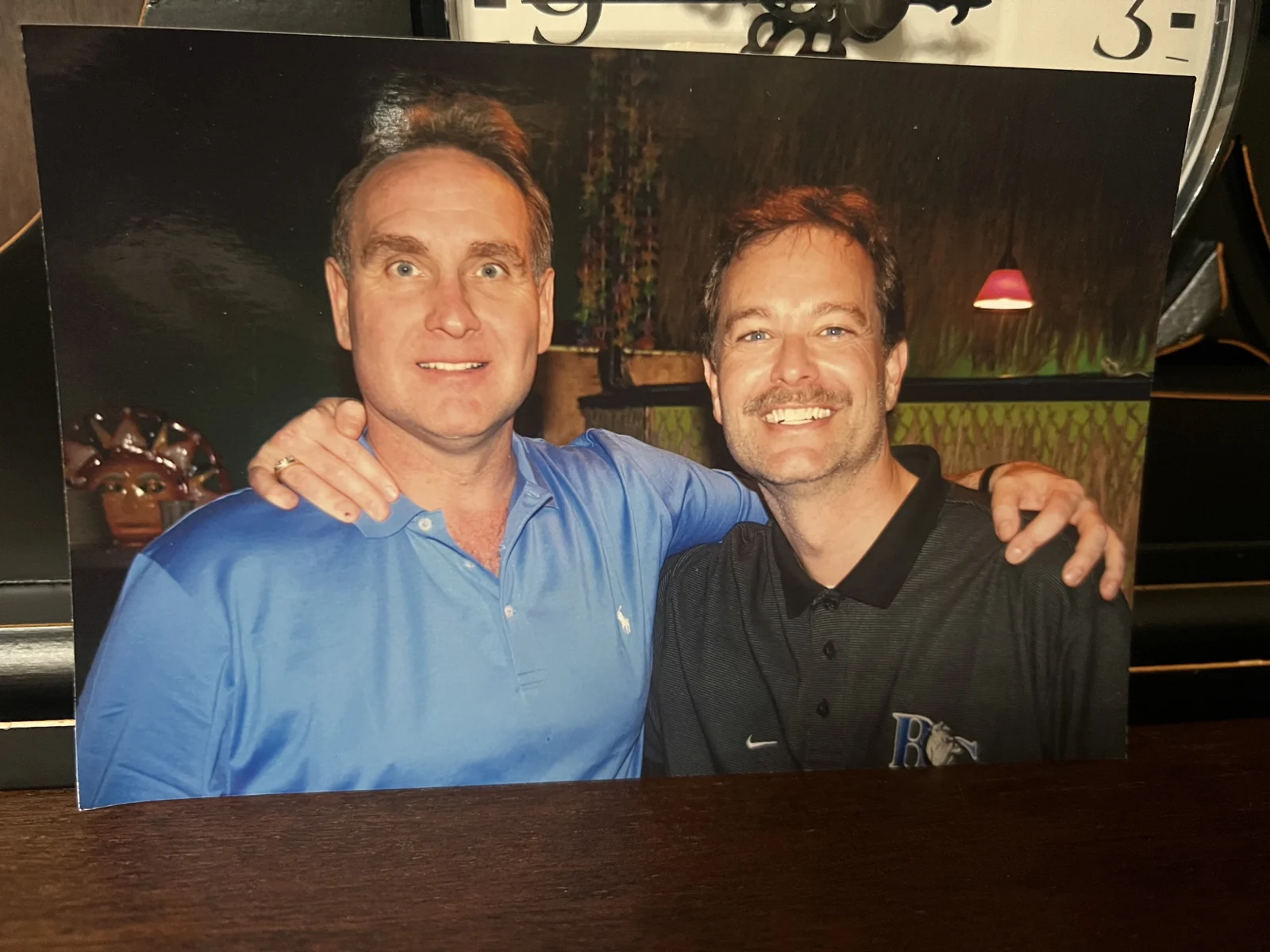
Mike Eatmon and Coach Ron Lievense during the 2007 season. The framed photograph preserves a moment in the friendship at the heart of this book.
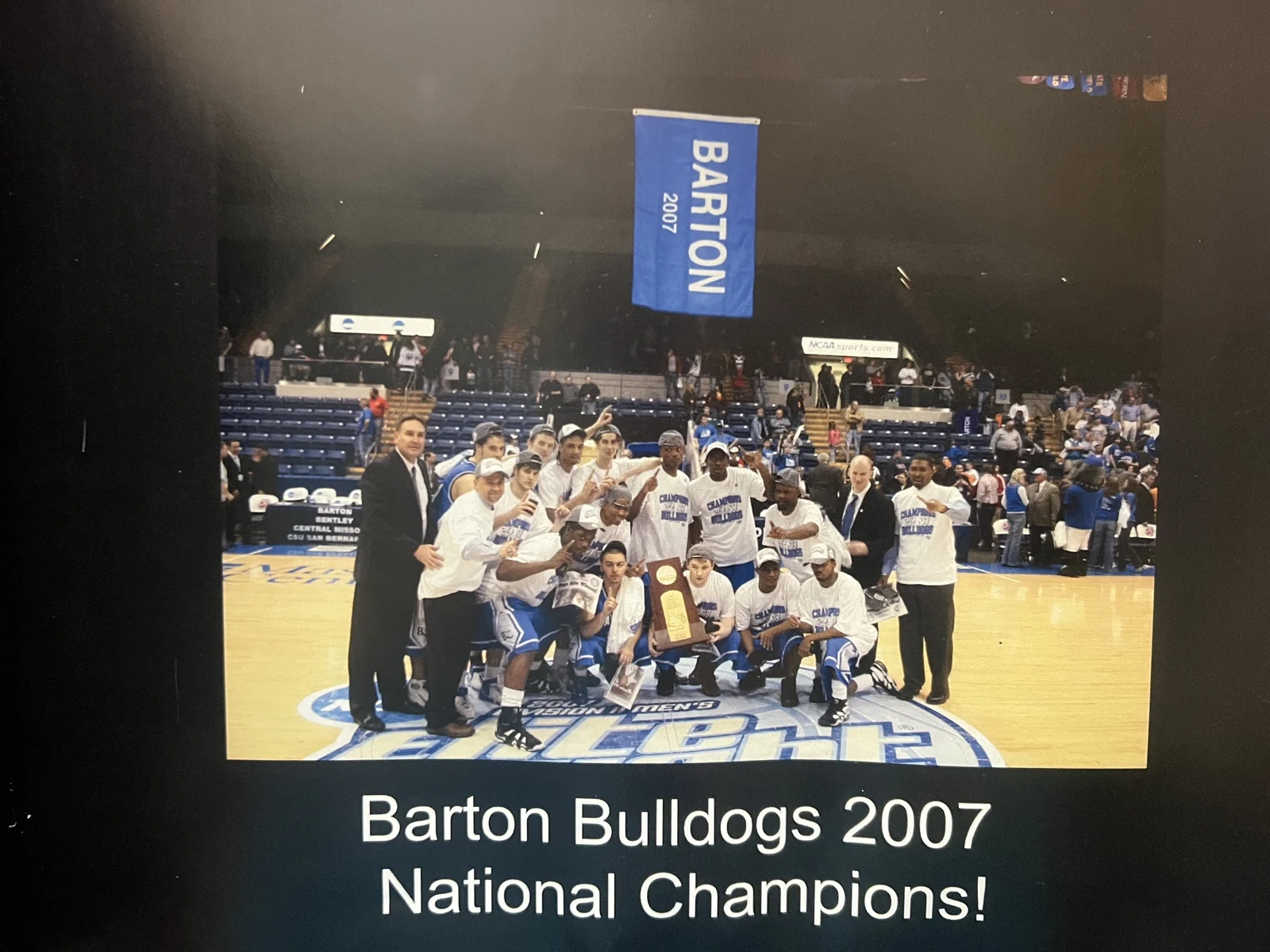
The signed 2007 championship team picture still sits in Mike Eatmon’s real estate office in Wilson, North Carolina.
Photographs supplied for this book. The images reproduce the framed photographs; the identities, season and office location were provided with them.
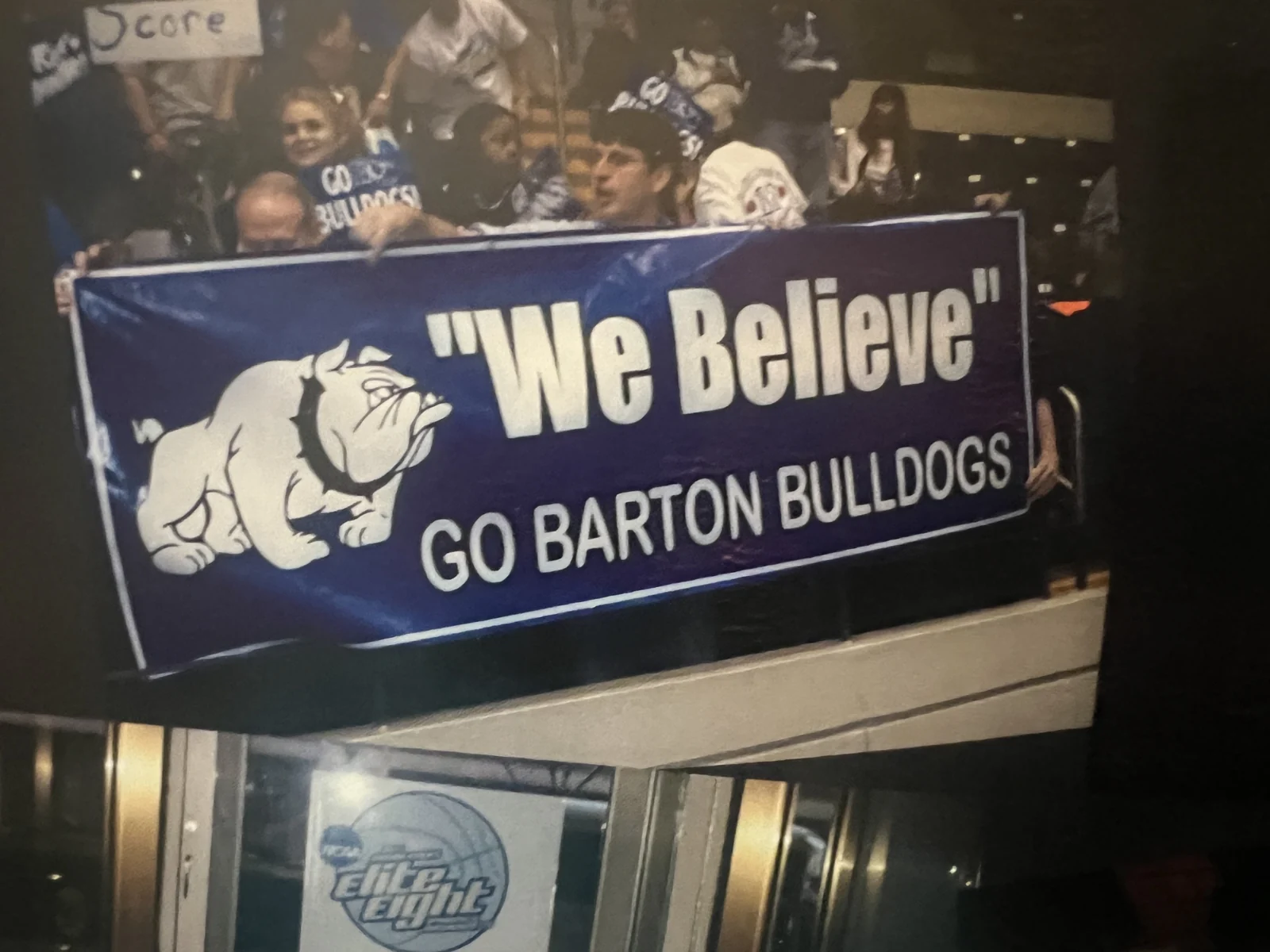
The words our supporters carried. The supplied photograph preserves a “We Believe” banner; it does not establish when the chant first began.
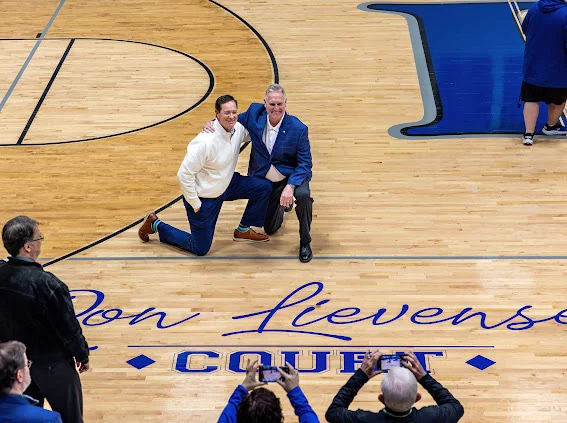
Mike and Ron on Ron Lievense Court at a later commemorative occasion. This photograph belongs to the friendship's continuing story, not to the 2007 championship game.
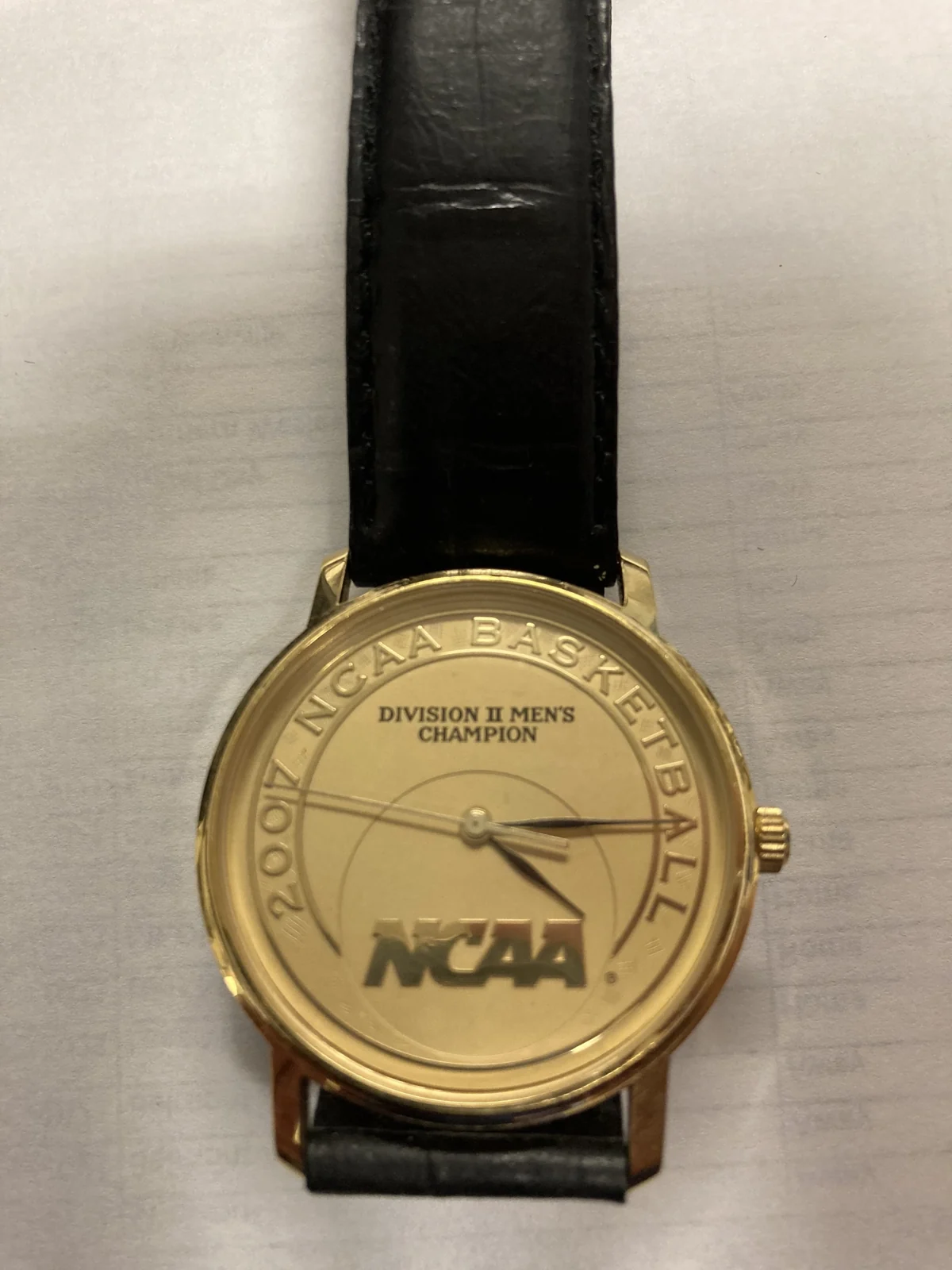
A championship keepsake photographed among the supplied materials. The picture does not identify the watch's wearer or establish ownership.
Continue the Story

Scan this code to visit the official companion website for photographs, reading and listening options, and information about print and group copies. The site identifies the edition of each recording and download. A recording of an earlier edition may differ from the text in this book.
The website address is https://www.bartonmiracle.com/.
A Note on the Record
When I say “we,” I often mean Barton the way a fan means his team. The players and coaches earned the championship. I was their friend and supporter.
My memories of the season are joined here by Ron Lievense's account, other participants' published recollections, and the records of the games. For Ron's early life, private team conversations, and coaching decisions, I rely on the people who described them. Remembered conversations are paraphrased where the substance is clearer than the exact words. My October 5, 2026 recording explains why I want to tell this story and adds memories of my own. The street-naming proposal and Ron's response in Chapter 24 are my recollection; no independent account of that exchange has been established. The reported response is not a quotation taken from Ron's interview, and the account does not establish a formal street-naming proceeding.
My later recordings add the accounts of our courtside place at home, the cards and messages Ron sent me, the Life Savers invitation, and the newspaper conversation. The reporter's name, newspaper, and later church attendance have not been established. Roger Temple's shared-game attendance and place to my left come from my written recollection supplied for this book; they do not establish his presence at a particular tournament.
Richard J. Wood's photographed letter is dated March 26, 2007. It does not name the supporter he describes; the association with me comes from Brandon's identification of the document. His account does not mention the mints or Jim. The printed tribute WELL DONE RON!! is credited to me, but its publication date and outlet are not established. These pages summarize the two documents rather than reproducing their private identifying details.
Two recorded conversations also develop the post-loss meeting, Alejo's return, the final-day Fellowship of Christian Athletes breakfast, the chant, and the airport welcome. These are participants' recollections. The FCA breakfast is distinct from the published account of Ant doing his devotions at breakfast. Ron's account explicitly places the FCA event on the day of the final; an older interview's uncertain weekday is not used to change the verified March 24 game date. The discussions do not establish the private religious beliefs of every player or the motives of opposing players.
Shereen Mitchell's signed season scrapbook supplies another fan's record. Her account places the chant at the March 14, 2006 regional against Alderson-Broaddus; Ron and I tentatively associated its beginnings with January during our later conversation. The narrative preserves those as differing recollections rather than assigning an invented settled date. Photographed clippings, captions, and handwriting are identified as parts of that scrapbook, not independent verification of every statement they contain.
Official records govern scores, dates, statistics, and the sequence of possessions. The championship feed logs the winning layup at one second. The contemporary NCAA account places its release at two-tenths; later Barton accounts describe one-tenth remaining after review. Shot release, basket and reviewed time remaining are different events. The feed also logs Malvik's final turnover and Buffaloe's steal at different whole-second times. They describe one change of possession, not two. The narrative preserves those limits instead of manufacturing one precise clock reading. The printed timeline uses the official feed's whole-second entries.
The chapter title Fifteen Routes to Wilson follows the contemporary team material explored in the narrative. The North Carolina resolution in Appendix A names seventeen players. Those are different lists.
The faith in these pages is my understanding of the season. The records establish what happened on the court; the meaning I draw from it is part of what I share as a person who was there.
Appendix A: Players and Coaches Recognized in 2007
Players named in the North Carolina resolution: Anthony Atkinson; Alejo Barovero; Spenser Briggs; Bobby Buffaloe; Jeff Dalce; L. J. Dunn; Jarrett Eason; Mike Flowers; Errol Frails; Mark Friscone; Charles Gamble; Travis Johnson; David King; Brian Leggett; Bobby McNeil; Sam Pounds; Brandon Raffel.
Coaches named in the resolution: Ron Lievense; Joel Zimmerman; John Skinner; Mark Pounds.
Appendix B: The Season in Scores
Barton finished 31–5 and won its final twenty-one games. The scores below list Barton first; dates run from November 2006 through March 2007.
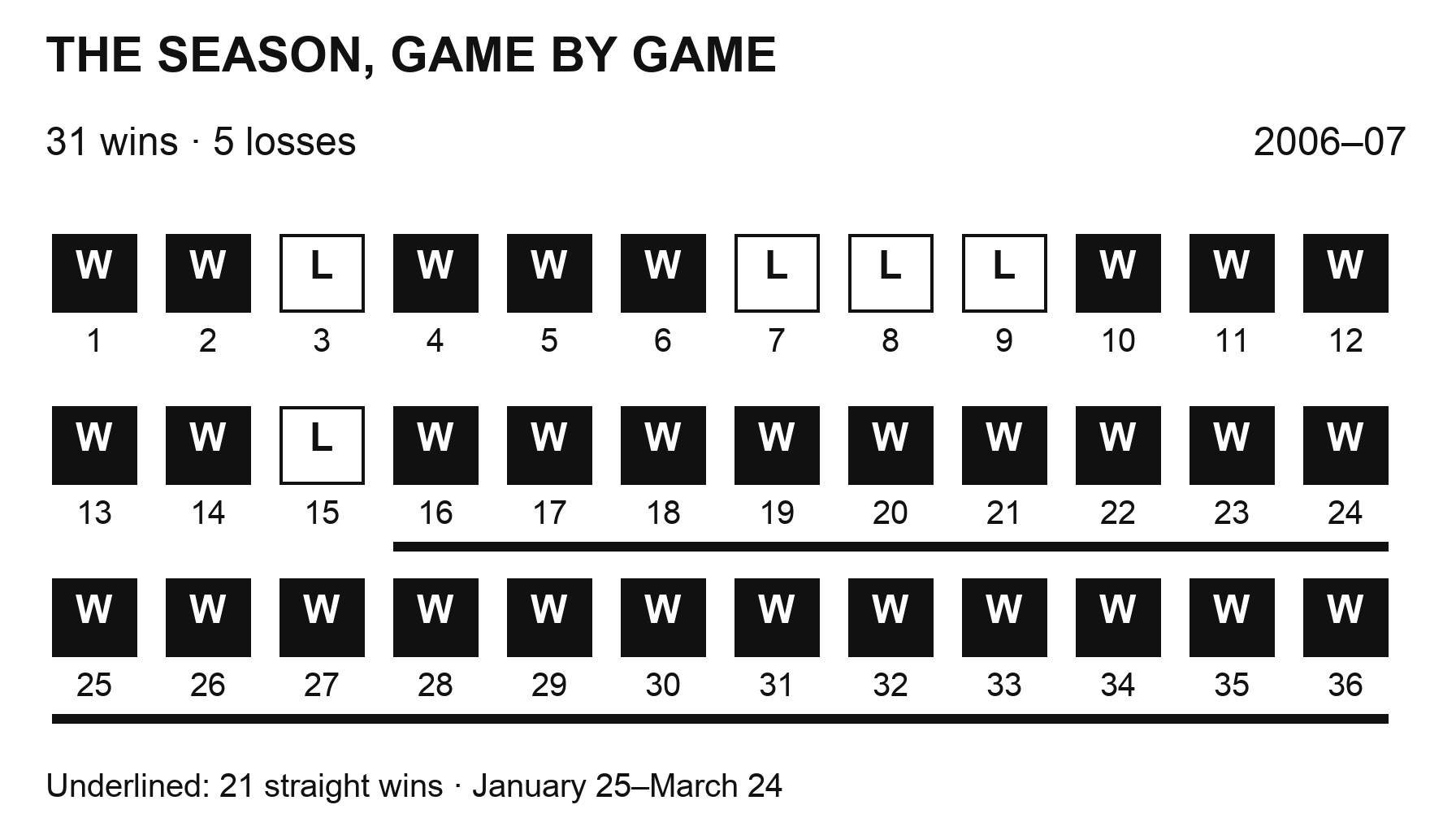
The season in order: each mark is one game. W denotes a win; L denotes a loss. The underlined stretch contains Barton’s final twenty-one victories, from January 25 through March 24.
| Date | Opponent | Result | Score |
|---|---|---|---|
| November 15 | Elizabeth City State | Win | 83–82 |
| November 17 | Saint Augustine’s | Win | 106–102 |
| November 18 | North Carolina Central | Loss | 65–67 |
| November 21 | St. Andrews | Win | 68–55 |
| November 29 | Coker | Win | 77–70 |
| December 2 | Lees-McRae | Win | 94–66 |
| December 5 | Chowan | Loss | 74–78 |
| December 29 | Catawba | Loss | 76–79 |
| December 30 | Lenoir-Rhyne | Loss | 61–95 |
| January 6 | Erskine | Win | 75–68 |
| January 8 | Pfeiffer | Win | 122–97 |
| January 13 | Anderson | Win | 98–64 |
| January 15 | Queens | Win | 101–94 |
| January 18 | Mount Olive | Win | 80–73 |
| January 20 | Limestone | Loss | 80–83 |
| January 25 | Belmont Abbey | Win | 85–72 |
| January 27 | Erskine | Win | 68–50 |
| January 29 | Coker | Win | 84–52 |
| February 1 | St. Andrews | Win | 99–88 |
| February 3 | Lees-McRae | Win | 82–58 |
| February 7 | Chowan | Win | 94–90 |
| February 10 | Anderson | Win | 83–73 |
| February 12 | Mount Olive | Win | 86–82 |
| February 15 | Queens | Win | 95–87 |
| February 17 | Belmont Abbey | Win | 94–67 |
| February 22 | Pfeiffer | Win | 114–99 |
| February 24 | Limestone | Win | 88–80 |
| February 28 | Belmont Abbey | Win | 93–82 |
| March 2 | Limestone | Win | 86–81 |
| March 3 | Mount Olive | Win | 92–80 |
| March 10 | Queens | Win | 85–76 |
| March 11 | West Virginia State | Win | 86–85 |
| March 13 | Millersville | Win | 76–65 |
| March 21 | Grand Valley State | Win | 83–81 |
| March 22 | Cal State San Bernardino | Win | 80–79 |
| March 24 | Winona State | Win | 77–75 |
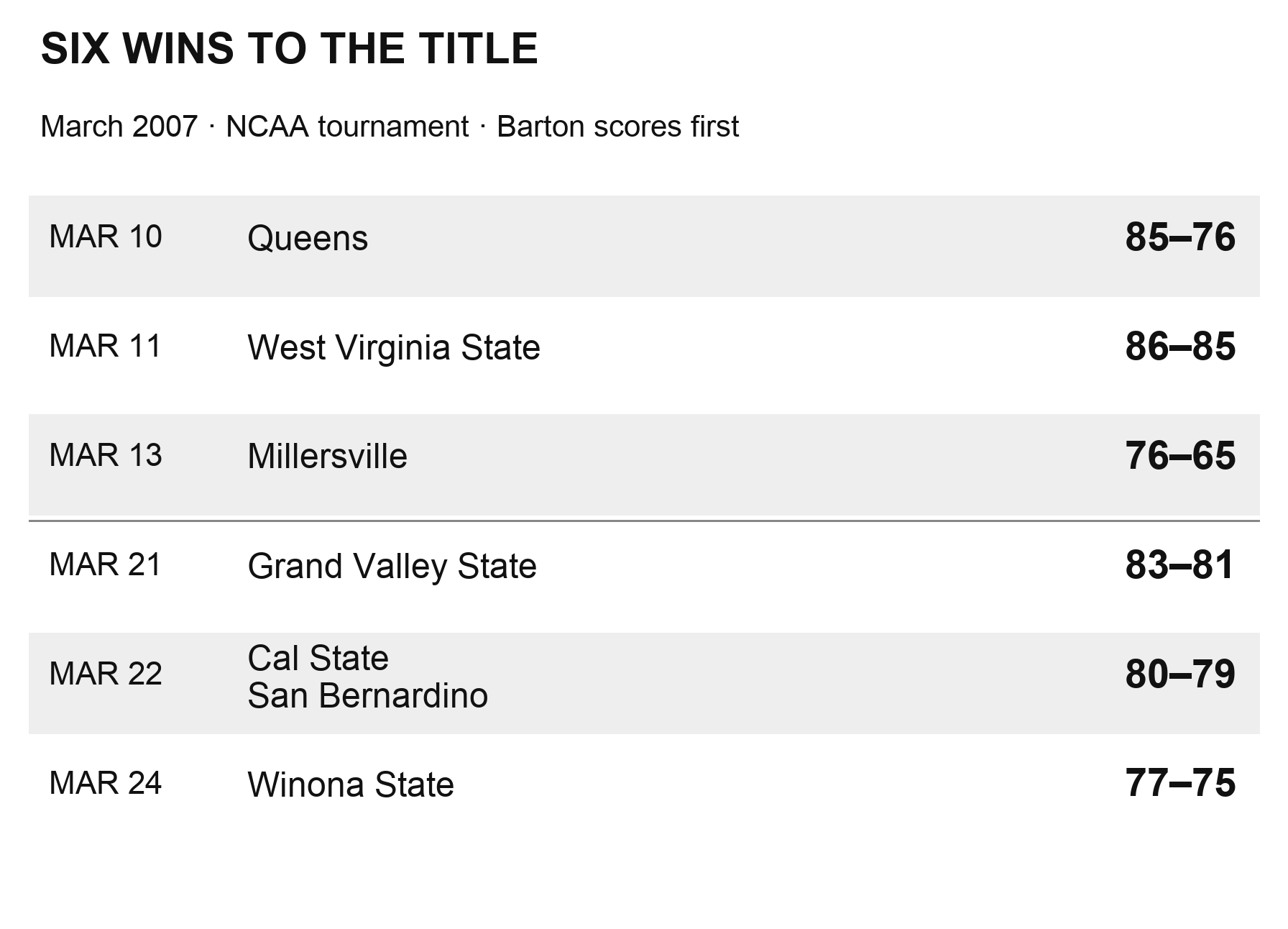
Six NCAA tournament wins carried Barton from Wilson to the national title. All dates are in March 2007; every score lists Barton first.
Appendix C: The Final Forty-Five Seconds
The official play-by-play controls the sequence below. Scores identify the leading team, followed by its points and Barton’s points until the tie.
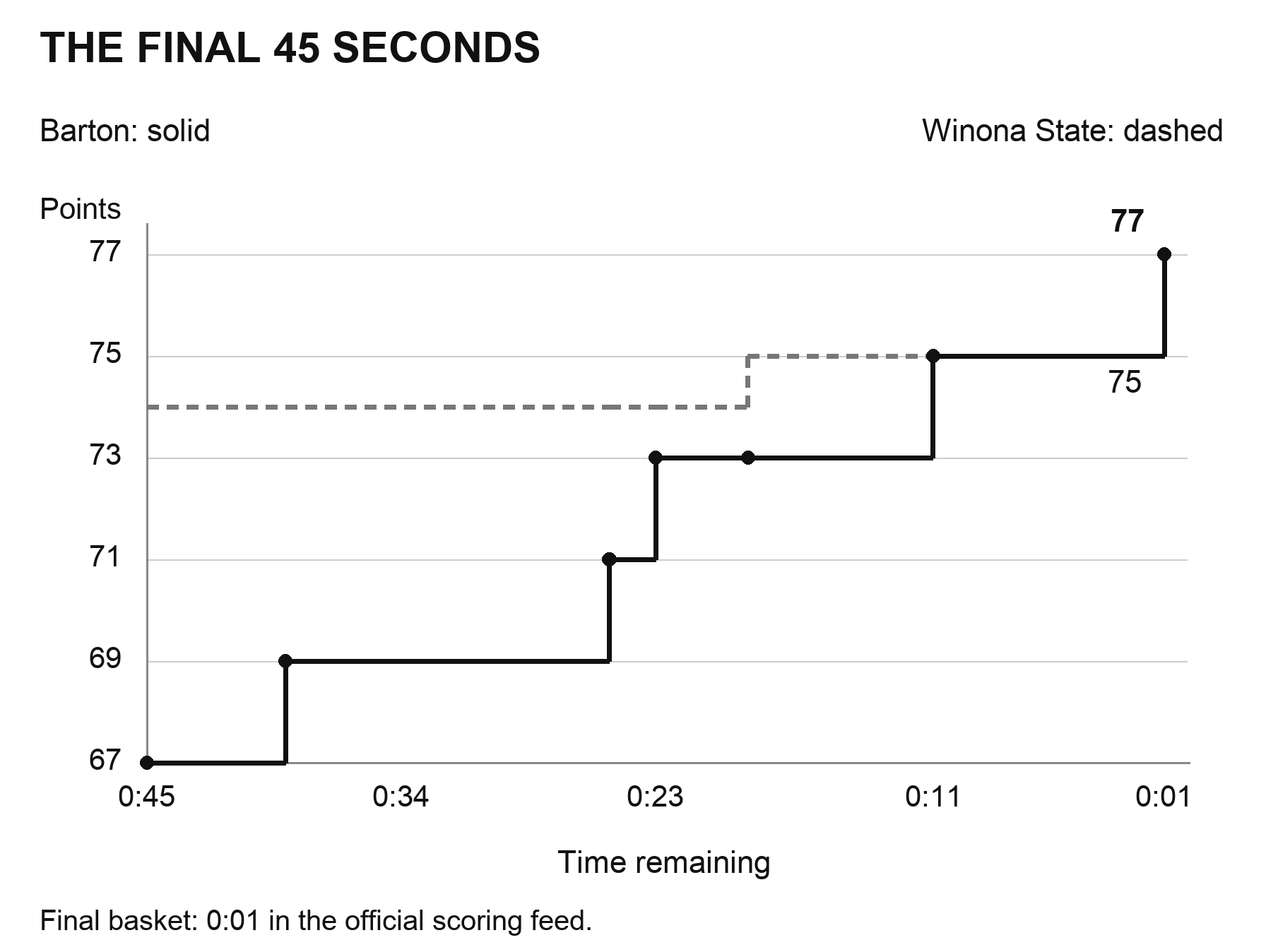
Barton’s solid line catches and passes Winona State’s dashed line. The final basket appears at 0:01 in the official feed; later accounts describe 0.1 seconds remaining after review.
0:45 — Zach Malvik makes two free throws. Winona State 74, Barton 67.
0:39 — Anthony Atkinson makes a layup. Winona State 74, Barton 69.
0:34 — Malvik misses a free throw; Brian Leggett rebounds. Winona State 74, Barton 69.
0:25 — Atkinson makes a jumper. Winona State 74, Barton 71.
0:24 — Errol Frails steals the inbound pass. Winona State 74, Barton 71.
0:23 — Atkinson makes a layup, assisted by Frails. Winona State 74, Barton 73.
0:22 — Atkinson misses a free throw. Winona State 74, Barton 73.
0:19 — Jonte Flowers misses one free throw and makes one. Winona State 75, Barton 73.
0:11 — Atkinson makes a layup. Tied 75–75.
0:05 — Zach Malvik turnover logged. Tied 75–75.
0:03 — Bobby Buffaloe credited with the steal. Tied 75–75.
0:01 — Atkinson makes the winning layup. Barton 77, Winona State 75.
The official scoring feed logs the last basket at 0:01. Later Barton accounts describe 0.1 seconds remaining after review.
Selected Sources
Official championship box score and play-by-play
NCAA News account of the 2007 championship and semifinal
CCAA championship history confirming the 80–79 semifinal
North Carolina resolution recognizing the team
L. J. Dunn Hall of Fame profile
Official Millersville regional-final box score
Grand Valley State quarterfinal box score and play-by-play
Anthony Atkinson Hall of Fame profile
Ron Lievense Hall of Fame profile
Barton retrospective preserving participant recollections
Barton announcement of Ron Lievense’s retirement
The account also draws on the project’s Ron Lievense interview and recording, Mike Eatmon’s recorded call and shorter recollections, his October 5, 2026 recording known as ‘Mike’s ode to Ron,’ the recovered Barton team materials, and the prior manuscript. Automated transcripts aid access to the recordings; they are not independent historical corroboration. Retrospective reporting contains some inconsistent scores and time estimates; the official championship record and the contemporary NCAA semifinal report govern those details here.
Acknowledgments
My thanks begin with Ron and Darla Lievense and their family, and with the players who gave our community so much to cheer for. I am grateful to the assistant coaches, staff, families, and supporters whose work carried the program through ordinary days as well as extraordinary ones.
Shereen Mitchell helped give our fans words we needed to say and preserved a season scrapbook that lets us hear another supporter remembering it. Jim Baldridge helped me take the invitation around an arena. Friends at Raleigh Road Baptist Church and throughout Wilson made a small college's team part of our lives. Mark Friscone gave me a gift I will always associate with the people behind the signatures.
I thank the scorers, archivists, journalists, and institutions that preserved the results and recollections. Their work helps a fan check his memory and tell a better story.
Edited by Brandon Narron.
Reader Reflection and Group Discussion Guide
1. A First Introduction
My friendship with Ron and Darla began at church; my brief attendance at Atlantic Christian had come years earlier. Think of a relationship that began without any expectation of becoming important. What helped it grow? Who is new to your community now?
2. A Place to Serve
Ron understood coaching as a way to help young men grow. I describe his accountability to God as an audience of one. Where do your abilities put you in contact with people you can serve? What would good work look like there if it never received public recognition?
3. Asking What Is Needed
Helping the team began, in part, with asking Ron about something practical: shoes. When have you discovered that the help somebody needed differed from the help you expected to offer?
4. Hearing a Hard Truth
After the loss at Lenoir-Rhyne, Ron described a meeting in which players and coaches spoke honestly to one another. What makes that kind of conversation possible? How can responsibility be shared without making accountability disappear?
5. Making Room
Alejo's injury changed the team. His return required another adjustment. Where have changed circumstances altered your role? What helped you recognize the value of somebody whose contribution had become different?
6. Beyond Regulation
Barton won nine overtime games that season. What habits help you continue when work lasts longer than you expected? Which person or practice steadies you when you are tired?
7. We Believe
Shereen's encouragement challenged my discouragement. The chant became something a crowd could offer together. Think about the difference between insisting on an outcome and helping somebody remain engaged. What does your encouragement ask of the person receiving it?
8. The People in the Possession
Ant scored the final baskets; other players recovered the ball and made those opportunities possible. Choose a success from your own life and name the people whose contributions a short account might omit.
9. The Other Team
Winona State's excellence was part of what made Barton's win extraordinary. How do you speak about people whose disappointment accompanies your success? What does respect ask of you after a competition ends?
10. Gratitude and Faith
What does the word miracle mean to you in this story? If your group includes different beliefs, make room for each person to answer. How can a testimony express conviction while remaining attentive to other people's experience?
11. The Signed Ball
Mark's gesture let me know the encouragement had been noticed. Whose faithful presence have you taken for granted? What would be a fitting, specific way to thank that person?
12. After the Season
Ron's account of his father's former players suggests a measure of coaching that lasts beyond eligibility. Which relationships and habits do you hope will remain after your current season of work is finished? Name one action you can take this week to care for them.